Fleet Insurance Renewal Process: A Manager's Guide
- Guyorguy Laguerre
- 20 hours ago
- 11 min read


TL;DR:
The fleet insurance renewal process involves structured review, document preparation, regulatory filings, and negotiations to ensure continuous coverage. Starting 90 days before expiration and maintaining organized records help fleet operators secure better terms and compliance. Proper management of claims, driver data, and FMCSA filings significantly influences renewal success and cost control.
The insurance renewal process for fleets is defined as the structured sequence of policy review, documentation assembly, regulatory filing, and insurer negotiation that commercial vehicle operators must complete before their current coverage expires. Missing a step in this sequence does not just mean higher premiums. It can mean suspended operating authority, uninsured vehicles on the road, and direct legal liability. Fleet managers who treat renewal as a 30-day scramble consistently pay more and get less. Those who start 8 to 12 weeks out with organized documentation and a clear filing timeline hold the leverage.
Commercial fleet insurance renewal is not a passive event where your insurer sends a bill and you pay it. It is an active underwriting process where your claims history, driver records, fleet composition, and risk management practices are all re-evaluated. Understanding each stage of the fleet coverage renewal process, from document preparation through FMCSA filings to final negotiation, is what separates fleets that control their costs from those that absorb whatever terms the market offers.
What documents and data are essential for a smooth fleet insurance renewal?
A complete renewal submission requires at minimum a full fleet schedule, Confirmed Claims Experience covering 3 to 5 years, driver license and MVR check evidence, and a risk management summary, with preparation starting 8 to 12 weeks before renewal. That timeline is not arbitrary. Underwriters need time to evaluate your submission, and carriers need time to price it competitively. Rushing this stage hands the insurer all the leverage.
The core documents every fleet renewal needs
Your fleet schedule is the foundation of the entire submission. It must list every vehicle by VIN, year, make, model, current market value, use class, and garaging location. Outdated schedules are one of the most common and costly errors in fleet renewals. A mismatch between actual fleet composition and what is submitted leads to either premium waste on vehicles you no longer operate or uninsured risk on vehicles that were added without notification.

Your driver roster requires the same discipline. Every driver must be listed with their license number, date of birth, years of experience, and current MVR status. The Florida commercial auto renewal checklist from Greene & Associates codifies MVR review, garaging details, vehicle use, and safety controls as non-negotiable elements of a professional submission. Insurers use MVR data to price individual driver risk, and a single unlisted driver with a poor record can invalidate a claim.
Beyond vehicles and drivers, your submission needs business registration documents, operational details like primary routes and annual mileage, and any contracts that specify minimum insurance requirements. For HGV operators, an Operator License and OCRS score are also required. Risk management summaries, including driver training logs, telematics reports, and safety system documentation, round out a complete pack.
Document | Purpose |
Fleet schedule (VIN, value, use class) | Establishes the insured assets and their risk classification |
Confirmed Claims Experience (3 to 5 years) | Primary underwriting input for pricing and market access |
Driver roster with current MVRs | Identifies individual driver risk and license compliance |
Business registration and operational details | Confirms legal entity, routes, mileage, and cargo types |
Risk management summary | Documents training, telematics, and safety systems to support pricing |
Pro Tip: Order your loss runs at least 120 days before your policy expiration date. This gives you time to address open claims, dispute inaccuracies, and present a clean, contextualized claims history to underwriters rather than a raw data dump.
Incomplete submissions can face delays of 5 to 10 working days and pricing that is 8 to 15 percent worse compared to well-prepared packs. A complete, organized submission can yield quotes within 24 to 48 hours. That speed advantage is not just convenient. It gives your broker time to shop multiple carriers and negotiate from a position of strength.
How does the FMCSA filing process affect U.S. fleet insurance renewals?
For U.S. motor carriers, the insurance renewal process for fleets includes a federally mandated filing layer that has no equivalent in most other industries. The BMC-91 form is the primary filing that proves to the FMCSA that a carrier maintains the minimum required liability coverage. Without an active BMC-91 on file, a carrier’s operating authority is suspended, and every mile driven is both illegal and uninsured.
Here is how the FMCSA filing timeline works in practice:
Binding: Your new or renewed policy is bound by the insurer, typically 1 to 3 days before the effective date.
Electronic submission: The insurer submits the BMC-91 filing electronically to the FMCSA, usually within 1 to 3 days of binding.
FMCSA processing: The FMCSA processes the filing, which takes 7 to 21 days to reflect as active in the SAFER system.
Verification: The fleet manager or compliance officer verifies active status on the SAFER system before resuming operations if there was any gap.
MCS-90 endorsement: This separate endorsement, attached to the policy itself, provides a public liability backstop and must also be confirmed as part of the renewed policy documents.
The gap between when your old policy expires and when the new BMC-91 is confirmed active in SAFER is the most dangerous window in the entire renewal cycle. Lapses in BMC-91 filings cause automatic operating authority suspensions, and reinstatement is neither fast nor cheap. The recommended practice is a 5 to 7 day policy overlap, where the new policy is bound and the BMC-91 is submitted before the old policy expires.
“Verifying SAFER status is not a one-time check at renewal. It is a continuous compliance responsibility, especially during the 21-day processing window when your filing may be in transit.” — FMCSA Insurance Filings Compliance Guide
Pro Tip: Set a calendar reminder to check your SAFER system status every 3 days during the FMCSA processing window. Do not assume the filing went through because your insurer confirmed submission. Confirm it yourself.
Common pitfalls that trigger authority suspensions include late premium payments that cause mid-term cancellations, carrier switches where the new BMC-91 is not submitted before the old one is withdrawn, and administrative errors in the filing itself. Working with a broker who specializes in trucking insurance renewals and understands FMCSA filing mechanics is not optional for regulated carriers. It is a compliance requirement disguised as a business preference.
What operational and risk management factors influence renewal pricing and coverage?
Underwriters evaluate commercial fleet insurance renewals through a risk lens, not a loyalty lens. Your claims history is the single most influential factor in determining both your renewal premium and which carriers will quote your account. A fleet with three at-fault accidents in 24 months will face restricted market access regardless of how long they have been with their current insurer.
Claims history and documented risk management activities strongly influence renewal pricing and market access. Underwriters prioritize claims history and value corrective actions like driver training and telematics when determining renewal terms. This means your job before renewal is not just to report what happened. It is to document what you did about it.
Driver records and their direct cost impact
MVR results translate directly into premium dollars. A driver with a DUI conviction, multiple speeding violations, or an at-fault accident in the past 3 years will increase the rate applied to every vehicle that driver operates. Some carriers will decline to quote an account if more than a defined percentage of the driver roster has adverse MVR results. Pulling MVRs 90 days before renewal gives you time to address problem drivers through additional training, reassignment, or separation before underwriters see the data.
Operational changes since your last renewal also require disclosure and documentation. Route expansions into higher-crime or higher-congestion areas, increases in annual mileage, changes in cargo type (particularly hazardous materials), and additions of new vehicle classes all shift your risk profile. Failing to disclose these changes is not just a pricing error. It is a coverage gap that can void a claim.
Here is what a strong risk management package communicates to underwriters:
Telematics data: Speed compliance rates, hard braking frequency, and idle time reports show behavioral trends across the fleet.
Driver training logs: Documented completion of defensive driving courses, cargo securement training, and hours-of-service compliance training.
Safety system records: Dashcam installation, lane departure warning systems, and automatic emergency braking documentation.
Incident response protocols: Written procedures for post-accident drug testing, vehicle inspection, and claim reporting.
Remediation records: Evidence that drivers with adverse events received coaching, retraining, or corrective action.
Pro Tip: Order loss runs early at 120 days before expiration and work to close or reduce open claims before your renewal submission. An open claim with no reserve reduction signals unresolved risk to underwriters and directly inflates your renewal premium.
Claims patterns over time matter more than any single incident. A fleet with a consistent pattern of minor rear-end collisions, for example, signals a systemic driver behavior problem that telematics and training can address. Spotting and correcting these trends before renewal, then documenting the correction, is the most direct path to better pricing. Insurers reward fleets that demonstrate they understand their own risk and actively manage it.
What are best practices for negotiating and managing the fleet coverage renewal process?
Negotiating a fleet insurance renewal is not about arguing with your insurer. It is about presenting your fleet’s risk profile so clearly and favorably that multiple carriers compete for your account. That competition is what produces better terms. The following steps represent the standard of practice for fleet managers who consistently secure competitive renewals.
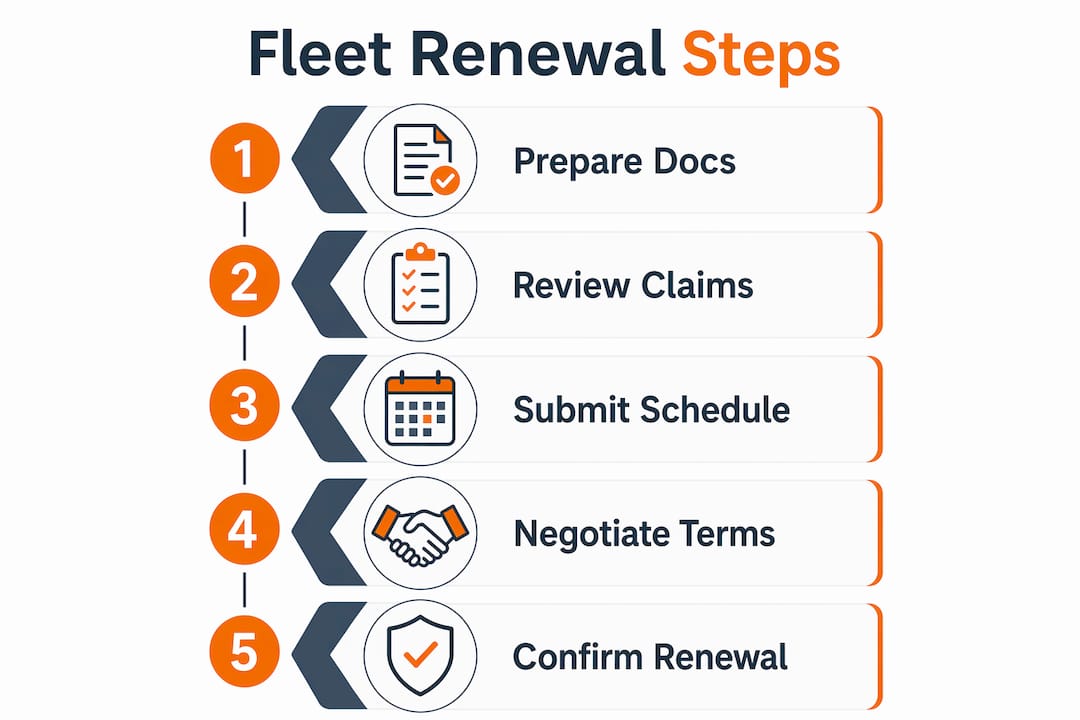
Start 90 days out. Starting renewal reviews 90 days prior increases negotiation leverage and access to competitive markets compared to starting 30 to 60 days out. Brokers need time to approach multiple carriers, and carriers need time to underwrite properly.
Build a document master pack. Combine your fleet schedule, driver lists, MVRs, loss runs, safety controls, contracts, and filings into a single organized submission. A document master pack enables rapid market access and improved negotiation positions.
Use your claims experience strategically. Present your Confirmed Claims Experience with context. If your loss ratio improved year over year, lead with that trend. If you had a bad year followed by documented corrective action, frame the narrative before the underwriter draws their own conclusions.
Shop the market actively. Your current carrier’s renewal offer is a starting point, not a final answer. Brokers who specialize in commercial fleet insurance can access surplus lines markets, specialty carriers, and program markets that a generalist broker cannot reach.
Negotiate coverage structure, not just price. Deductible adjustments, coverage sublimit changes, and endorsement additions often deliver more value than a small premium reduction. A higher deductible on physical damage with a lower liability premium, for example, may suit a fleet with strong cash reserves and a clean liability record.
Avoid late submissions. Submitting your renewal package less than 30 days before expiration eliminates your ability to negotiate. Carriers quote late submissions defensively, with higher rates and fewer options.
Document everything in writing. Coverage changes, endorsement additions, and verbal agreements with brokers must be confirmed in writing before the policy binds. Verbal commitments are not coverage.
Approach | Outcome |
Start 90 days before expiration | Multiple carrier quotes, full negotiation window, better terms |
Start 30 days before expiration | Limited market access, defensive pricing, reduced leverage |
Complete document master pack | Quotes in 24 to 48 hours, underwriter confidence, competitive pricing |
Incomplete or late submission | 5 to 10 day delays, 8 to 15 percent worse pricing, restricted market |
Documented risk management package | Premium credits, broader coverage options, preferred market access |
No risk management documentation | Standard or substandard pricing, limited carrier options |
Understanding fleet insurance terms like combined single limits, scheduled auto versus symbol 7 coverage, and MCS-90 endorsements before you sit down with your broker means you can evaluate what you are actually buying, not just what it costs. Brokers who specialize in fleet accounts will use this language fluently. You should too.
Key takeaways
The fleet insurance renewal process requires structured preparation starting 90 days out, complete documentation, active FMCSA filing verification, and documented risk management to secure competitive terms and continuous coverage.
Point | Details |
Start 90 days before expiration | Early preparation gives brokers time to shop multiple carriers and negotiate better terms. |
Build a complete document master pack | Fleet schedule, MVRs, loss runs, and safety records together accelerate underwriting and improve pricing. |
Verify FMCSA filings actively | Check SAFER system status every few days during the 7 to 21 day processing window to prevent authority gaps. |
Document risk management efforts | Telematics data, training logs, and incident protocols directly influence underwriter pricing decisions. |
Negotiate coverage structure, not just price | Adjusting deductibles, limits, and endorsements often delivers more value than chasing a lower premium number. |
Why most fleet renewals go wrong at the same point
After working through hundreds of commercial fleet insurance submissions, the pattern is consistent. Fleets that struggle at renewal do not fail because of bad luck or a difficult market. They fail because they treat the renewal as an administrative task rather than a strategic one. The document pack gets assembled in the final two weeks. The loss runs arrive with open claims that nobody addressed. The broker gets a rushed submission and returns a rushed quote.
The counterintuitive truth about fleet insurance renewal is that the work that matters most happens months before the renewal date. Closing an open claim in month nine of a twelve-month policy period is worth more than any negotiation tactic in month eleven. Pulling MVRs in month nine and addressing a driver with three violations is worth more than arguing about the rate applied to that driver at renewal.
I have seen fleets with genuinely poor loss histories secure better-than-expected renewals because they came to the table with a documented remediation story. Underwriters are not just pricing past losses. They are pricing future risk. If you can demonstrate that the conditions that produced those losses no longer exist, you change the underwriter’s forward-looking assessment. That is where real pricing leverage lives.
The other mistake I see consistently is treating the broker relationship as transactional. A broker who specializes in fleet accounts and knows your operation can advocate for you in ways that a generalist cannot. They know which carriers are hungry for fleet business in your segment, which underwriters respond to telematics data, and how to frame a challenging loss history. That knowledge is worth more than the commission they earn. Build that relationship before you need it, not during the renewal crunch.
— Guyorguy
How Insuaria helps fleet operators prepare for renewal
Getting your fleet renewal documentation organized before you engage with a licensed insurance professional is exactly where Insuaria is built to help. Insuaria’s business intake platform is designed for fleet operators and business owners who need to organize vehicle details, driver information, operational data, and coverage history into a structured format that licensed agency partners can work with efficiently.

Insuaria is not an insurance company or broker, and it does not bind coverage or issue quotes. What it does is make the first step of the insurance review process faster and more organized, so the licensed professionals who follow up have everything they need to go to market on your behalf. If you are approaching a fleet renewal and want to get your information in order before the clock runs out, Insuaria’s intake tools are built for exactly that situation. Start your fleet insurance intake today and give your broker the submission they need to compete for your account.
FAQ
What is the insurance renewal process for fleets?
The fleet insurance renewal process is the annual cycle of reviewing current coverage, updating fleet and driver documentation, submitting regulatory filings, and negotiating new policy terms with insurers before the existing policy expires. It requires structured preparation starting at least 8 to 12 weeks before the renewal date.
How early should I start the fleet insurance renewal process?
Start at least 90 days before your policy expiration date. Starting 90 days out gives brokers time to approach multiple carriers and negotiate better terms, compared to the restricted options available when starting 30 to 60 days out.
What happens if my BMC-91 filing lapses during renewal?
A lapse in BMC-91 filing causes automatic suspension of your FMCSA operating authority, making every mile driven both illegal and uninsured. Reinstatement requires a new filing and another 7 to 21 day FMCSA processing period, during which operations must cease.
How does claims history affect fleet insurance renewal pricing?
Claims history is the primary underwriting factor in commercial fleet insurance renewals. Underwriters evaluate 3 to 5 years of loss runs, and fleets with documented corrective actions following losses, such as driver retraining or telematics implementation, consistently receive better renewal terms than those with unaddressed claim patterns.
What documents do I need for a fleet policy renewal checklist?
A complete fleet policy renewal checklist includes the full fleet schedule with VINs and vehicle values, Confirmed Claims Experience for 3 to 5 years, current driver MVRs, business registration documents, operational details, and a risk management summary covering training and safety systems.
Recommended
Comments