Insurance Certificates Explained for Business Owners
- Guyorguy Laguerre
- 3 hours ago
- 10 min read


TL;DR:
A certificate of insurance verifies active coverage at the time of issuance but does not guarantee ongoing protection or rights.
Verifying endorsements, limits, and exact policy details beyond the COI is essential for proper risk management.
A certificate of insurance (COI) is a document issued by an insurance company or broker that verifies active coverage and summarizes key policy details including coverage types, limits, and effective dates. Most business owners encounter a COI when signing a contract, leasing commercial space, or hiring a vendor. The document looks straightforward, but misreading it or over-relying on it creates real gaps in risk management. This guide covers insurance certificates explained from the ground up, including how to read them, what they cannot do, which forms to expect, and how to manage them without letting anything slip through the cracks.
What are insurance certificates and what do they contain?
A COI is not a policy. It is a one-page summary that confirms a policy exists at the moment it was issued. COIs are routinely required in contracts, leases, and vendor agreements so that each party can verify the other carries the required coverage before work begins or a deal closes.

The standard fields on every COI
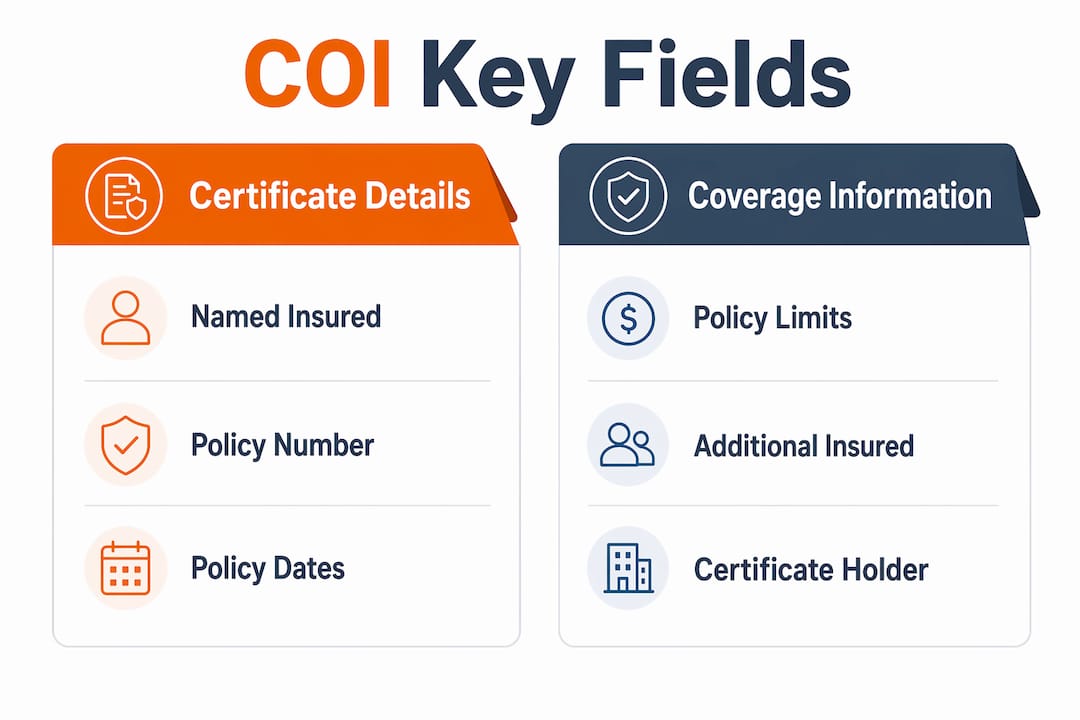
Understanding insurance certificates starts with knowing what each field means. Here are the core elements you will find on any COI:
Named insured. The individual or business entity covered by the policy. This name must match the contracting party exactly. A mismatch between the named insured and the vendor name on your contract is a red flag.
Insurer information and NAIC number. The NAIC (National Association of Insurance Commissioners) number identifies the carrier. Use it to verify the insurer is licensed and financially stable in your state.
Coverage types. Common lines listed include commercial general liability (CGL), commercial auto, umbrella or excess liability, and workers’ compensation. Each line confirms a separate policy is in force.
Policy limits. Limits are shown per occurrence and in aggregate. A $1 million per occurrence / $2 million aggregate CGL policy means the insurer pays up to $1 million per single claim and no more than $2 million across all claims in the policy period.
Effective and expiration dates. These dates define the active policy period. A COI dated today with a policy expiring next week is nearly worthless for a year-long contract.
Certificate holder. The party requesting the COI. Being listed here does not grant any coverage rights on its own.
Additional insured and endorsement references. Checkboxes or notes indicating whether additional insured status or a waiver of subrogation has been requested. These boxes alone do not confirm coverage. The underlying endorsement must be verified separately.
Pro Tip: When you receive a COI, cross-reference the key fields on the COI against your contract’s insurance requirements line by line. Limits, coverage types, and endorsement language all need to match before you sign anything.
The most widely used standardized form for liability coverage is the ACORD 25. Property insurance uses ACORD 27 (evidence of property insurance) and ACORD 28 (evidence of commercial property insurance). Knowing which form you are looking at tells you immediately what type of coverage is being summarized.
Field | What to verify |
Named insured | Matches the contracting party name exactly |
Policy limits | Meets or exceeds contract minimums |
Effective/expiration dates | Covers the full contract period |
Certificate holder | Your company name is listed correctly |
Endorsements | Additional insured and waiver of subrogation are confirmed |
What a COI cannot do: limitations vs. the actual policy
A COI is informational evidence, not a contract. A COI does not amend, extend, or guarantee coverage and does not create rights for the certificate holder. The underlying insurance policy and its endorsements control what is actually covered. This distinction matters more than most people realize.
Here is what that means in practice:
A COI reflects coverage at the moment of issuance only. Policies can be canceled, modified, or allowed to lapse after a COI is printed. COIs do not track mid-term policy changes, so a certificate issued in January may not reflect a cancellation that happened in March.
Checked boxes are not endorsements. The additional insured checkbox on an ACORD 25 signals that the status was requested. It does not confirm the endorsement was actually added to the policy. Only the endorsement form itself, attached to the policy, provides that confirmation.
Coverage gaps can exist even with a valid COI. If the policy has exclusions, sublimits, or conditions that conflict with your contract requirements, the COI will not reveal them. The policy document is the only authoritative source.
Certificate holders have no direct rights. Being listed as a certificate holder does not make you an additional insured. It simply means you were given a copy of the summary. Rights flow from endorsements, not from the COI itself.
The COI cannot override the policy. Courts have consistently held that a COI is not a binding contract. If the COI states broader coverage than the actual policy, the policy terms prevail.
Pro Tip: Always request a copy of the actual endorsement form alongside the COI when your contract requires additional insured status or a waiver of subrogation. A COI without the supporting endorsement is incomplete documentation.
The practical takeaway is to treat a COI as a starting point for verification, not the finish line. It tells you that a policy likely exists. It does not tell you whether that policy will actually respond to a claim involving your project or contract.
What are the main types of insurance certificates and forms?
The type of COI you need depends on the coverage being verified. The insurance industry has standardized most COI formats through ACORD, the Association for Cooperative Operations Research and Development. Using standardized forms reduces errors and makes it easier to compare certificates across vendors.
ACORD Form | Coverage type | Common use case |
ACORD 25 | Liability (CGL, auto, umbrella, workers’ comp) | Construction contracts, vendor agreements, lease requirements |
ACORD 27 | Personal lines property insurance | Mortgage lenders, personal auto lenders |
ACORD 28 | Commercial property insurance | Commercial leases, lenders requiring proof of property coverage |
ACORD 855 | Endorsement schedule | Documenting specific endorsements attached to a policy |
The ACORD 25 is the standard form for liability coverage and is the form most businesses encounter. It covers general liability, commercial auto, umbrella, and workers’ compensation on a single page. Construction companies, logistics firms, and service contractors use it constantly because general contractors and property owners require it before any work begins.
ACORD 27 and ACORD 28 serve a different purpose. A mortgage lender requires an ACORD 27 to confirm a homeowner carries property insurance. A commercial landlord requires an ACORD 28 to verify a tenant’s building coverage. The distinction between liability and property certificates matters because the coverage types, limits, and verification steps are entirely different.
For trucking and transportation businesses, the ACORD 25 is especially critical. Liability coverage for trucking fleets involves multiple coverage lines, and brokers and shippers routinely require current ACORD 25 certificates before dispatching loads or approving carrier packets. Specialized forms like ACORD 855 document the endorsement schedule and are used when a contract requires proof of specific endorsements beyond what the ACORD 25 can show.
Why endorsements matter more than the COI itself
Endorsements are the modifications attached to an insurance policy that add, remove, or change coverage. The COI summarizes the policy. The endorsement changes it. Additional insured status, waiver of subrogation, and primary/noncontributory wording all depend on policy endorsements, not on what is checked on the COI form.
This is where most COI-related coverage disputes originate. Here is what each common endorsement does and why it requires verification beyond the COI:
Additional insured endorsement. Extends the named insured’s liability coverage to a third party, such as a general contractor or property owner. The scope of this coverage varies significantly. An “ongoing operations” endorsement covers work in progress. A “completed operations” endorsement covers claims that arise after the work is finished. Contracts often require both, and verifying endorsement scope against contract demands is the only way to confirm compliance.
Waiver of subrogation. Prevents the insurer from pursuing the certificate holder for reimbursement after paying a claim. Without this endorsement in place, your vendor’s insurer could sue you even after paying your vendor’s claim. The COI checkbox signals the request. The endorsement form confirms it exists.
Primary and noncontributory wording. Specifies that the named insured’s policy responds first before any other coverage the certificate holder carries. Without this language, two insurers may dispute which policy pays first, delaying claims resolution.
Pro Tip: Request the actual endorsement forms, not just the COI, before finalizing any contract that requires additional insured status. COI endorsement compliance issues frequently arise because the COI lists additional insured language without a supporting endorsement copy, making true contractual risk transfer impossible to verify.
Confusing certificates with endorsements is one of the most common mistakes in COI administration. A COI can note that an endorsement was requested. Only the endorsement itself confirms it was granted and defines its scope.
How to request, review, and manage COIs effectively
Getting a COI is straightforward. Managing them well across multiple vendors, contracts, and renewal cycles is where most businesses struggle. Effective COI management involves reviewing contract requirements, requesting accurate certificates, verifying endorsements, setting expiration reminders, and renewing certificates on time.
Follow these steps to build a reliable COI process:
Pull the insurance requirements from every contract before requesting a COI. Know the required coverage types, minimum limits, endorsements, and certificate holder language before you contact the vendor or their broker.
Send a written request with specific requirements. Do not ask for “a certificate of insurance.” Specify the ACORD form needed, the coverage types and limits, the certificate holder name and address, and any required endorsements. Vague requests produce incomplete certificates.
Review the COI against your checklist immediately upon receipt. Check the named insured, limits, dates, certificate holder, and endorsement references. Accuracy verification is crucial risk management because operational risk arises when COI details do not match contract requirements.
Request endorsement copies for any additional insured or waiver of subrogation requirements. Do not accept a checked box as confirmation.
Set calendar reminders 30 and 60 days before each COI expiration. Standard practice is to request new COIs upon policy renewal because COIs do not automatically reflect mid-term changes like cancellations or endorsement removals.
Store COIs in a centralized, searchable location. A shared drive organized by vendor name and expiration date works for small businesses. Larger operations benefit from dedicated certificate tracking software.
Flag discrepancies in writing before work begins. If a vendor’s COI shows limits below your contract requirements, document the gap and require a corrected certificate before proceeding.
Pro Tip: Build a one-page COI checklist specific to each contract type you use regularly. A construction contract checklist looks different from a vendor services checklist. Having a template ready reduces review time and prevents oversights.
The most common pitfall in COI administration is treating the process as a one-time task. Policies renew, endorsements change, and vendors switch carriers. A COI that was accurate in January may be outdated by July. Treating COI management as an ongoing process rather than a box to check at contract signing is what separates businesses that manage risk well from those that discover gaps after a claim.
Key takeaways
A certificate of insurance proves coverage exists at a moment in time, but the underlying policy and its endorsements determine whether a claim will actually be paid.
Point | Details |
COI is not a policy | A COI summarizes coverage but does not amend, extend, or guarantee it. |
Endorsements require separate verification | Additional insured and waiver of subrogation must be confirmed via endorsement forms, not COI checkboxes. |
ACORD 25 is the standard liability form | Use ACORD 25 for liability coverage; ACORD 27 and 28 apply to property insurance. |
COIs expire and go stale | Policies can change mid-term; always re-request certificates at renewal and track expiration dates. |
Match COI details to contract requirements | Limits, named insured, dates, and endorsements must align with contract language before work begins. |
The part most businesses skip entirely
I have reviewed hundreds of COI-related situations over the years, and the pattern is almost always the same. A business collects a COI, files it, and considers the job done. Nobody requests the endorsement forms. Nobody checks whether the named insured on the certificate matches the entity that signed the contract. Nobody sets a reminder for the expiration date. Then a claim happens, and the coverage that everyone assumed existed turns out to be narrower than expected or missing entirely.
The uncomfortable truth about COIs is that they create a false sense of security when used carelessly. A one-page document that says “general liability: $1,000,000 per occurrence” feels like protection. But if the additional insured endorsement was never actually added to the policy, or if it covers ongoing operations but not completed operations, that protection does not extend to you when you need it most.
Small businesses are especially vulnerable here because they often lack a dedicated risk manager. The person handling vendor contracts is also handling accounts payable, scheduling, and a dozen other things. COI review gets compressed into a 30-second glance. That is exactly when gaps form.
My advice is to slow down the COI review process deliberately. Build a checklist. Request endorsement copies as a standard part of every vendor onboarding. Set renewal reminders the day you receive a new certificate. These are not complicated steps. They are just easy to skip when you are busy. The businesses that manage COIs well are not doing anything sophisticated. They are simply being consistent.
One more thing worth saying directly: a COI is a tool for verification, not a substitute for understanding the actual coverage. If a vendor’s policy has a significant exclusion that affects your project, the COI will not tell you. That is why the COI process works best as part of a broader insurance review, not as a standalone compliance checkbox.
— Guyorguy
How Insuaria helps you organize your insurance information

Getting your insurance documentation in order before working with a licensed professional saves time and reduces errors. Insuaria is a compliance-first intake and referral platform that helps individuals, business owners, and trucking companies organize the details licensed insurance professionals need to review coverage. Through simple intake forms and educational resources, Insuaria makes it easier to submit information related to business, auto, trucking, and other coverage types before a licensed agency partner follows up. If you are ready to get your business insurance intake organized and start the review process on the right foot, Insuaria is built for exactly that. Insuaria does not provide insurance advice, bind coverage, or issue quotes. All coverage decisions are handled by licensed professionals.
FAQ
What is a certificate of insurance used for?
A certificate of insurance is used to verify that a business or individual carries active insurance coverage. COIs are required in contracts, leases, and vendor agreements so parties can confirm the required coverage exists before work begins or a deal closes.
Does a COI guarantee that a claim will be covered?
No. A COI does not guarantee coverage and does not create rights for the certificate holder. The actual insurance policy and its endorsements determine whether a claim is covered.
What is the difference between ACORD 25 and ACORD 28?
ACORD 25 is the standard form for liability coverage, including general liability, commercial auto, umbrella, and workers’ compensation. ACORD 28 is used for commercial property insurance and is typically required by lenders or landlords verifying building coverage.
How often should I request a new COI from a vendor?
Request a new COI at every policy renewal and any time a vendor’s coverage changes. COIs do not reflect mid-term policy changes like cancellations or endorsement removals, so an outdated certificate may not represent current coverage.
Is being listed as a certificate holder the same as being an additional insured?
No. Being listed as a certificate holder means you received a copy of the COI summary. Additional insured status requires a specific policy endorsement and grants actual coverage rights under the named insured’s policy.
Recommended
Comments