Motor Carrier Liability for Fleet Operators: 2026 Guide
- Guyorguy Laguerre
- 1 day ago
- 10 min read


TL;DR:
Motor carrier liability involves the legal responsibility carriers bear for bodily injury and property damage during freight transport. Understanding this liability, regulated by the Carmack Amendment and insurance requirements, is essential for compliance and risk management in trucking operations. Proper documentation, timely claims filing, and aligned insurance coverage are critical to mitigate exposure and avoid costly legal or financial pitfalls.
Motor carrier liability is the legal obligation carriers bear for bodily injury and property damage caused during the transportation of goods, governed by federal law, the Carmack Amendment, and mandatory insurance requirements. Understanding motor carrier liability is not optional for truck operators and fleet managers. It determines your compliance standing, your exposure in a lawsuit, and whether your insurance actually covers what you think it does. This guide covers the regulatory minimums, the freight claims framework, the exceptions that can work for or against you, and the coverage gaps that catch carriers off guard every year.
What does understanding motor carrier liability mean for your operation?
Motor carrier liability, in its formal legal sense, refers to the financial and legal responsibility a licensed carrier assumes the moment freight is loaded and a bill of lading is signed. The Federal Motor Carrier Safety Administration (FMCSA) sets the regulatory floor, the Carmack Amendment governs freight loss and damage claims, and your insurance policy is the mechanism that funds those obligations. These three systems operate together, but they are not the same thing. Confusing them is one of the most expensive mistakes a fleet operator can make.
The liability framework applies to every interstate for-hire carrier operating under FMCSA authority. Owner-operators leased to a carrier, small fleets running regional lanes, and large national carriers all fall under the same legal structure. The scale of your operation changes your premium, not your legal exposure.
What are the federal insurance and financial responsibility requirements?
The FMCSA sets minimum liability limits at $750,000 for general freight, $1,000,000 for certain oils, and $5,000,000 for hazardous materials. These numbers represent the absolute floor. Most brokers and shippers contractually require $1,000,000 in primary liability regardless of freight type, which means the federal minimum is rarely the practical minimum for carriers seeking consistent load access.

The BMC-91 and BMC-91X filings
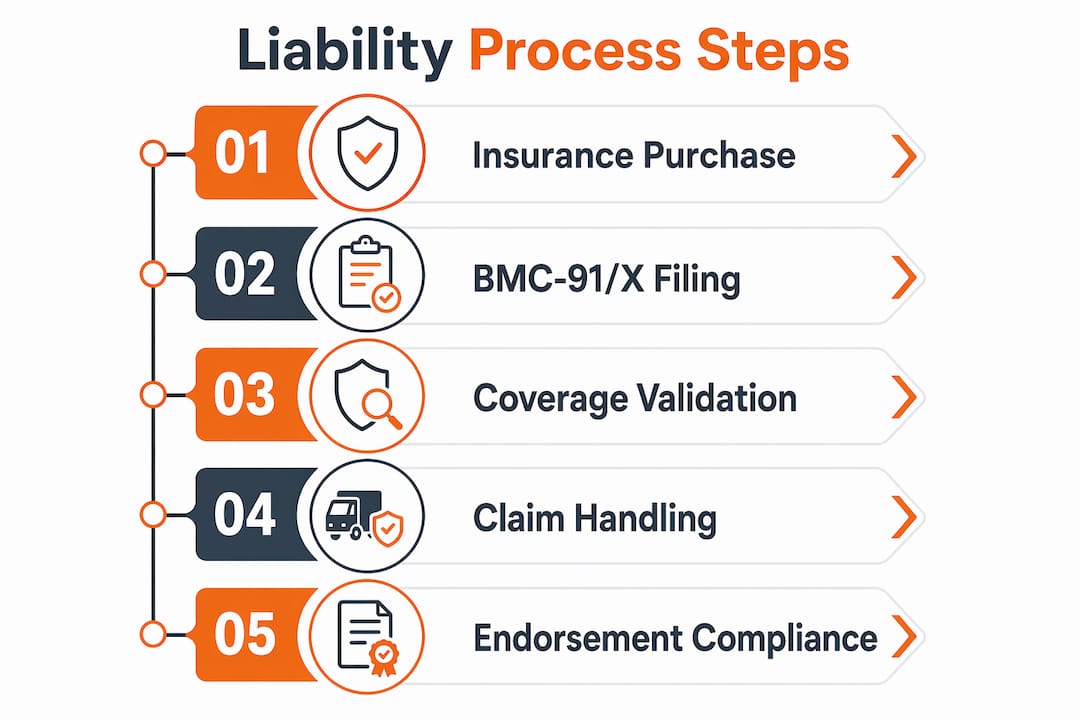
Beyond carrying the right policy, you must file proof of that coverage with the FMCSA. The BMC-91 or BMC-91X filing is the mechanism that connects your insurance policy to your operating authority. Filing processing can take up to two weeks, and a lapse in filing can suspend your authority even if your premium is paid and your policy is active. That distinction matters. Paying your premium does not protect your authority. The filing does.
Coverage types every carrier needs to understand
Primary liability insurance covers bodily injury and property damage to third parties caused by your truck. It does not cover your cargo. Cargo insurance is not federally mandated, but it is contractually required by nearly all shippers and brokers, commonly starting at $100,000 in coverage. Refusing to carry it means load tender refusals, not just legal exposure. Physical damage coverage protects your own equipment. Bobtail or non-trucking liability covers you when operating without a trailer and outside of dispatch. Each of these serves a distinct purpose, and none of them substitutes for the others.
Coverage type | What it covers | Federal requirement |
Primary liability | Bodily injury and property damage to third parties | Yes, via FMCSA minimums |
Cargo insurance | Loss or damage to the freight you haul | No, but contractually required |
Physical damage | Your own truck and trailer | No |
Bobtail/non-trucking | Off-dispatch operation without a trailer | No |
MCS-90 endorsement | Public liability when policy is breached | Required on primary policy |
Pro Tip: Request a certificate of insurance from your insurer that lists your FMCSA filing status. If the BMC-91 or BMC-91X is not current, your operating authority is at risk regardless of your coverage status.
How does the Carmack Amendment govern freight damage liability?
The Carmack Amendment, codified at 49 U.S.C. § 14706, is the federal law that governs motor carrier liability for freight loss and damage on interstate shipments. Under the Carmack Amendment, carriers are strictly liable for freight loss or damage. Strict liability means the shipper does not need to prove negligence. The carrier must prove a valid defense or pay. This effectively makes the carrier an insurer of the freight it hauls, which is why cargo insurance exists as a practical necessity even when it is not federally mandated.
How a freight claim actually works
The process follows a defined sequence under federal law:
Delivery and notation. The consignee notes visible damage on the delivery receipt at the time of delivery. Failure to note damage at delivery weakens the claim but does not eliminate it.
Claim filing. The shipper or consignee must file a written freight claim within nine months of delivery or the expected delivery date for non-delivery.
Carrier response. The carrier has 120 days to acknowledge, pay, deny, or make a settlement offer on the claim.
Lawsuit window. If the carrier denies the claim, the claimant has two years from the denial date to file suit.
These claim timelines are not suggestions. Missing the nine-month filing window typically bars the claim entirely. Missing the two-year lawsuit window does the same. Fleet managers should build these deadlines into their claims management workflow.
The bill of lading as your primary legal document
The bill of lading is both the contract of carriage and the primary evidence in any freight claim. It establishes what was tendered, in what condition, and at what declared value. A vague or incomplete bill of lading works against the carrier in a dispute because ambiguity tends to favor the shipper under the Carmack framework. Carriers should treat every bill of lading as a legal document, not an administrative form.
Pro Tip: Document cargo condition with timestamped photos at pickup and delivery. This evidence is not required by law, but it is the fastest way to defeat a fraudulent or exaggerated freight claim.
Carrier defenses under the Carmack Amendment
A carrier that cannot prove one of the recognized defenses pays the claim. The five accepted defenses are: act of God, act of a public enemy, act or default of the shipper, act of public authority, and the inherent nature or vice of the goods. Each defense requires documentation. “The freight was already damaged” is not a defense without a notation on the bill of lading or photographic evidence taken at pickup.
What common exceptions and nuances affect carrier liability exposure?
The strict liability standard under the Carmack Amendment has real limits, and carriers who understand those limits can manage their exposure more precisely. The exceptions listed above are the legal defenses, but there are also contractual mechanisms that can cap liability below the full value of the freight.
Liability caps in contracts require documented shipper consent and genuine freight rate concessions to be enforceable. Courts consistently invalidate released value provisions that were buried in fine print or offered without a corresponding rate option. The shipper must have a real choice between full liability at a higher rate and limited liability at a lower rate. Without that documented choice, the cap does not hold and full liability applies.
Common pitfalls that increase carrier exposure include:
Shipper load and count clauses. When the shipper loads and seals the trailer, the carrier’s liability for shortage or concealed damage is reduced. But this only applies when the bill of lading clearly states “shipper load and count” and the seal is intact at delivery.
Improper documentation of liability limits. Many carriers inadvertently expose themselves to full shipment value liability by failing to properly negotiate or document liability caps in their contracts.
Vicarious liability for driver actions. Carriers are legally responsible for the actions of their drivers during the course of employment. A driver who causes a truck accident while on dispatch creates liability for the carrier, regardless of whether the driver was an employee or a leased owner-operator.
Broker liability for negligent hiring. A 2026 Supreme Court ruling held that the FAAAA does not protect brokers from state tort claims for choosing unsafe carriers. This means brokers now scrutinize carrier safety records more aggressively, and carriers with poor CSA scores face both load access problems and increased legal exposure.
“Motor carrier liability is the ‘who owes what’ while insurance is ‘how it gets funded.’ Carriers must audit contracts against insurance sublimits to avoid gaps.” — Logrock
The practical takeaway is that liability exposure is not fixed. It expands when documentation is poor, contracts are vague, or insurance sublimits do not match the actual value of freight being hauled. Reviewing your contracts and your policy together, at least annually, is the only way to know your true exposure.
How do liability and insurance coverage actually interrelate?
Legal liability and insurance coverage are two separate systems that must be aligned deliberately. Liability defines what you owe. Insurance defines what gets paid. The gap between those two things is your personal financial exposure. Trucking insurance is more complex than standard commercial auto because of vicarious liability, federal endorsements, and the frequency of litigation in trucking claims.
Understanding the MCS-90 endorsement
The MCS-90 endorsement is required on every primary liability policy for FMCSA-regulated carriers. It obligates the insurer to pay valid public liability claims even when the carrier has breached the policy terms. This sounds like a safety net, but it is not a separate coverage. The insurer pays the claimant and then seeks reimbursement from the carrier for any amount paid due to a policy breach. Carriers who misunderstand the MCS-90 as extra protection often discover its true function after a claim.
Where coverage gaps actually appear
Policy sublimits and exclusions can cause carriers to pay losses personally even when headline limits appear sufficient. A policy with $1,000,000 in cargo coverage may have a $100,000 sublimit for theft or a complete exclusion for temperature-sensitive freight. If you haul refrigerated goods under a policy with a temperature failure exclusion, you carry the full loss personally. The types of liability coverage available to trucking fleets vary significantly by insurer and endorsement structure.
Liability type | Governed by | Insurance solution |
Freight loss or damage | Carmack Amendment | Cargo insurance |
Third-party bodily injury | State tort law and FMCSA | Primary liability insurance |
Off-dispatch incidents | State tort law | Bobtail/non-trucking liability |
Driver negligence (on dispatch) | Vicarious liability doctrine | Primary liability insurance |
Policy breach claims | MCS-90 endorsement | Carrier bears reimbursement risk |
Pro Tip: Ask your insurer for a full schedule of sublimits and exclusions, not just the headline coverage amounts. A $1,000,000 cargo policy with a $50,000 theft sublimit is not a $1,000,000 theft policy.
Carriers should also review their fleet insurance coverages annually against the actual freight they haul. A carrier that added a new commodity type mid-year without updating their policy may be operating with a coverage gap they do not know about until a claim is denied.
Key takeaways
Motor carrier liability is a strict legal standard that requires carriers to pay for freight loss or damage unless they can prove a recognized defense, and insurance is the funding mechanism that must be deliberately aligned with that liability.
Point | Details |
Federal minimums are the floor | FMCSA requires $750,000 to $5,000,000 in liability coverage depending on freight type. |
Carmack Amendment sets strict liability | Carriers owe for freight damage without proof of negligence; defenses require documentation. |
BMC-91 filing is not optional | A lapsed filing suspends operating authority even when premiums are current. |
Liability caps require documented consent | Courts void released value limits without a genuine shipper choice and rate concession. |
Sublimits create hidden exposure | Headline policy limits may not reflect actual coverage due to exclusions and sublimits. |
What I’ve learned watching carriers get this wrong
Most of the liability problems I see are not caused by catastrophic accidents or bad faith insurers. They come from paperwork. A bill of lading that says nothing about cargo condition at pickup. A contract with a liability cap that was never properly offered to the shipper. A cargo policy with a theft sublimit that nobody read until after the trailer was stolen.
The Carmack Amendment’s strict liability standard is genuinely unforgiving. Carriers who treat it as a freight claims problem rather than an operational discipline problem keep losing claims they could have won. The defense is almost always available. The documentation to prove it is usually missing.
The MCS-90 misunderstanding is the other issue I see repeatedly. Carriers believe it protects them. It protects the public. The insurer pays the claimant and then comes after the carrier for reimbursement if the claim arose from a policy breach. That is not protection. That is a delayed bill.
My practical recommendation is to treat your bill of lading as a legal document from the moment it is signed, audit your insurance sublimits against your actual freight mix every year, and never assume a contract liability cap is enforceable without having it reviewed. The carriers who manage liability well are not doing anything complicated. They are doing the basics consistently, and they have a licensed insurance professional who understands trucking reviewing their coverage annually.
— Guyorguy
How Insuaria helps fleet operators organize their insurance review
Managing motor carrier liability coverage starts with knowing what you have and identifying where the gaps are. Insuaria is a compliance-first insurance intake and referral platform that helps trucking businesses organize the information licensed insurance professionals need to review their coverage.

Through Insuaria’s business insurance intake process, fleet operators can submit the details of their operation, freight types, and current coverage so a licensed agency partner can follow up with a thorough review. For carriers who need to start with truck-specific coverage details, the truck insurance intake form is built for exactly that purpose. Insuaria does not bind coverage or issue quotes. Licensed professionals handle that. Insuaria makes the first step organized and efficient.
FAQ
What is motor carrier liability?
Motor carrier liability is the legal obligation a licensed carrier bears for bodily injury and property damage caused during the transportation of goods. Under the Carmack Amendment, carriers are strictly liable for freight loss or damage on interstate shipments unless they prove a recognized defense.
What are the FMCSA minimum insurance requirements?
The FMCSA requires interstate for-hire property carriers to maintain minimum liability coverage of $750,000 for general freight, $1,000,000 for certain oils, and $5,000,000 for hazardous materials. Most brokers and shippers contractually require $1,000,000 regardless of freight type.
How long does a shipper have to file a freight claim?
Under the Carmack Amendment, shippers must file a written freight claim within nine months of delivery or the expected delivery date. Carriers then have 120 days to respond, and claimants have two years from a denial to file suit.
What is the MCS-90 endorsement and does it protect carriers?
The MCS-90 endorsement requires insurers to pay valid public liability claims even when a carrier breaches the policy, but it is not a separate coverage that protects the carrier. The insurer pays the claimant and then seeks reimbursement from the carrier for any amount paid due to a policy breach.
Can a carrier limit its liability below the full value of freight?
Yes, but only when the shipper is given a genuine choice between full liability at a standard rate and limited liability at a reduced rate, with that choice documented in the contract. Courts void released value caps that lack documented shipper consent and corresponding rate concessions.
Recommended
Comments