Truck insurance quoting guide: Secure the best coverage
- Guyorguy Laguerre
- May 11
- 11 min read


TL;DR:
Getting truck insurance wrong in 2026 can lead to high costs, compliance issues, and operating blackouts. Collecting accurate documents like DOT numbers, VINs, MVRs, and loss runs is essential for precise quoting and risk assessment. Comparing multiple quotes, leveraging safety technology, and increasing liability limits are critical for cost control and legal protection.
Getting truck insurance wrong in 2026 is expensive. Owner-operators pay $8,000 to $15,000 per year per truck, and new authorities face premiums 20 to 40% higher than established carriers. Beyond cost, a compliance gap can freeze your operating authority overnight. Whether you run one truck or manage a fleet of 50, the quoting process determines both what you pay and whether you stay legal. This guide walks you through exactly what you need, how insurers price risk, and how to find coverage that protects your business without draining your margins.
Table of Contents
What documents and details you need for a truck insurance quote
How premium quotes are calculated: Key risk factors and benchmarks
Federal and state minimums: Liability limits, compliance, and activation
Step-by-step: Getting multiple quotes and unlocking discounts
Common mistakes, cost pitfalls, and how to future-proof your quoting
Key Takeaways
Point | Details |
Gather all key documents | DOT/MC numbers, VINs, driver history, and cargo details are essential for quoting. |
Understand risk factors | Premiums are shaped by driver experience, claims history, cargo type, and location. |
Meet compliance minimums | Federal and broker standards set liability requirements that affect your quotes. |
Compare multiple quotes | Leverage independent agents, review apples-to-apples, and never auto-renew for best rates. |
Mitigate rising costs | Use safety technology and proactive strategies to offset premium increases in 2026. |
What documents and details you need for a truck insurance quote
With the stakes made clear, you must first gather the right materials before approaching insurers. Walking into a quoting conversation unprepared is one of the most common and costly mistakes operators make. Insurers price what they can verify, and missing documents either delay your quote or push your rate higher because the underwriter fills gaps with worst-case assumptions.
Truck insurance quoting requires detailed information including DOT and MC numbers, VINs for every truck, driver motor vehicle records (MVRs), loss runs covering three to five years, operational radius, cargo types and values, garaging locations, CSA scores, and any active safety programs. Each piece of data serves a specific underwriting purpose.
Here is what each item does for your quote:
DOT/MC numbers confirm your legal operating authority and let insurers pull your FMCSA safety record instantly
VINs identify the exact make, model, year, and value of each truck so underwriters can price physical damage accurately
Driver MVRs reveal violations, accidents, and license suspensions that directly affect your liability rate
Loss runs show your claims history so insurers can assess whether you are a repeat risk or a clean account
Cargo type and value determine which coverage endorsements apply and how much product liability exposure exists
Operational radius separates local, regional, and long-haul risk, since more miles in more states means more exposure
CSA scores (Compliance, Safety, Accountability scores from FMCSA) reflect your fleet’s overall safety performance and are one of the first things specialty carriers check
Pro Tip: Pull your loss runs from your current insurer before you start shopping. Most carriers require three to five years of history, and requesting them at the last minute can delay your quote by days.
Document | Why insurers need it | Impact on premium |
DOT/MC number | Verifies authority and safety record | High |
VIN per truck | Identifies vehicle for physical damage pricing | High |
Driver MVRs | Reveals violation and accident history | Very high |
Loss runs (3-5 yrs) | Shows claims frequency and severity | Very high |
CSA scores | Reflects fleet safety compliance | High |
Cargo type/value | Determines coverage endorsements needed | Medium to high |
Garaging location | Sets state-specific rate territory | Medium |
Following insurance tips for trucking companies when organizing these materials saves time and reduces back-and-forth with agents. You can also start the trucking intake process to organize your details before your first agent conversation.
How premium quotes are calculated: Key risk factors and benchmarks
Once your materials are organized, understanding what determines your quote prevents both sticker shock and missed savings. Insurers do not set premiums arbitrarily. They use actuarial models built on decades of claims data, and every factor in your profile either raises or lowers a base rate multiplier.
Insurers calculate premiums using a base rate multiplied by risk multipliers that range from 0.5 to 3.0 across 15 or more factors including driver records, operational radius, cargo type, claims history, FMCSA scores, and telematics use. Actuarial models target loss ratios of 60 to 65%, meaning insurers expect to pay out $60 to $65 in claims for every $100 in premium collected.
The main factors that move your multiplier are:
Driver experience and record — Drivers with fewer than two years of CDL experience or recent violations carry the highest multipliers. A single serious violation can increase a driver’s rate by 30% or more.
Claims history — Frequent small claims often hurt more than one large claim. Insurers see frequent claims as a behavioral pattern, not just bad luck.
Cargo type — Hazardous materials, refrigerated goods, and high-value electronics all carry higher multipliers than dry van freight.
Operational radius — Long-haul operations crossing multiple states expose carriers to more litigation risk, especially in high-verdict states like California, Florida, and Texas.
Telematics adoption — Fleets using GPS tracking and electronic logging devices often qualify for meaningful rate reductions because real-time data reduces insurer uncertainty.
“New authorities pay 20 to 40% more in premium until they build a two-year clean record; fleets with five or more trucks gain economies of scale that can reduce per-truck costs significantly.”
Risk factor | Low risk profile | High risk profile | Premium impact |
Driver experience | 5+ years, clean MVR | Under 2 years, violations | Up to +40% |
Claims history | Zero claims, 3-5 yrs | Multiple claims | Up to +35% |
Cargo type | Dry van, general freight | Hazmat, high-value cargo | Up to +50% |
Telematics use | Active GPS, dashcams | No monitoring tech | Up to -25% |
Fleet size | 10+ trucks | 1 truck | Per-truck discount |
Understanding these factors lets you present your operation in the most favorable light. Strategies for reducing premium costs often start with fixing the factors you can control before you shop. Learning more about understanding premium risks gives you a stronger foundation when reviewing quotes side by side. For newer carriers, reading up on commercial insurance confidence helps set realistic expectations.
Federal and state minimums: Liability limits, compliance, and activation
With risk factors in mind, it is crucial to meet compliance requirements or risk losing contracts and operating authority. Many operators assume meeting the federal floor is enough. It often is not.
FMCSA minimum liability requirements are $750,000 for general freight, $1 million for oil and non-bulk hazmat, and up to $5 million for high-risk hazmat loads. Brokers and shippers frequently require $1 million or more regardless of cargo type. Your insurer files a BMC-91X form directly with FMCSA to activate your operating authority, which means your coverage and your legal ability to operate are directly linked.
Key compliance facts every operator should know:
The $750,000 federal minimum has not been updated since 1985, which means it covers far less real-world liability than it did when it was set
Many large shippers and brokers require $1 million in auto liability as a contract condition, even for dry van freight
State-specific requirements can exceed federal minimums, particularly in states with aggressive litigation environments
If your insurer cancels or lapses your policy, FMCSA can revoke your operating authority within days
Important: A lapse in coverage does not just mean you are uninsured. It means you legally cannot operate until coverage is reinstated and the BMC-91X is re-filed. That downtime costs real money.
Cargo type | FMCSA minimum liability | Common broker/shipper requirement |
General freight (dry van) | $750,000 | $1,000,000 |
Oil, non-bulk hazmat | $1,000,000 | $1,000,000 |
High-risk hazmat | $5,000,000 | $5,000,000 |
Passenger transport | $5,000,000 | $5,000,000 |
Review the full liability coverage guide to understand how different coverage structures apply to your specific operation and cargo mix.
Step-by-step: Getting multiple quotes and unlocking discounts
Meeting minimums is not enough. Finding the best price and coverage takes deliberate effort and careful comparison. Most operators who overpay for insurance do so because they either accepted the first quote they received or let their policy auto-renew without shopping.
Getting three to five quotes from trucking specialists and independent agents, comparing them on an apples-to-apples basis across limits, deductibles, and exclusions, and reviewing annually is the baseline process. Using telematics and dashcams can unlock 15 to 25% in premium discounts.
Independent trucking-specialized agents access 10 to 20 carriers for the best rates versus going direct to a single insurer. Shopping 60 to 90 days before renewal gives you real leverage. Never auto-renew.
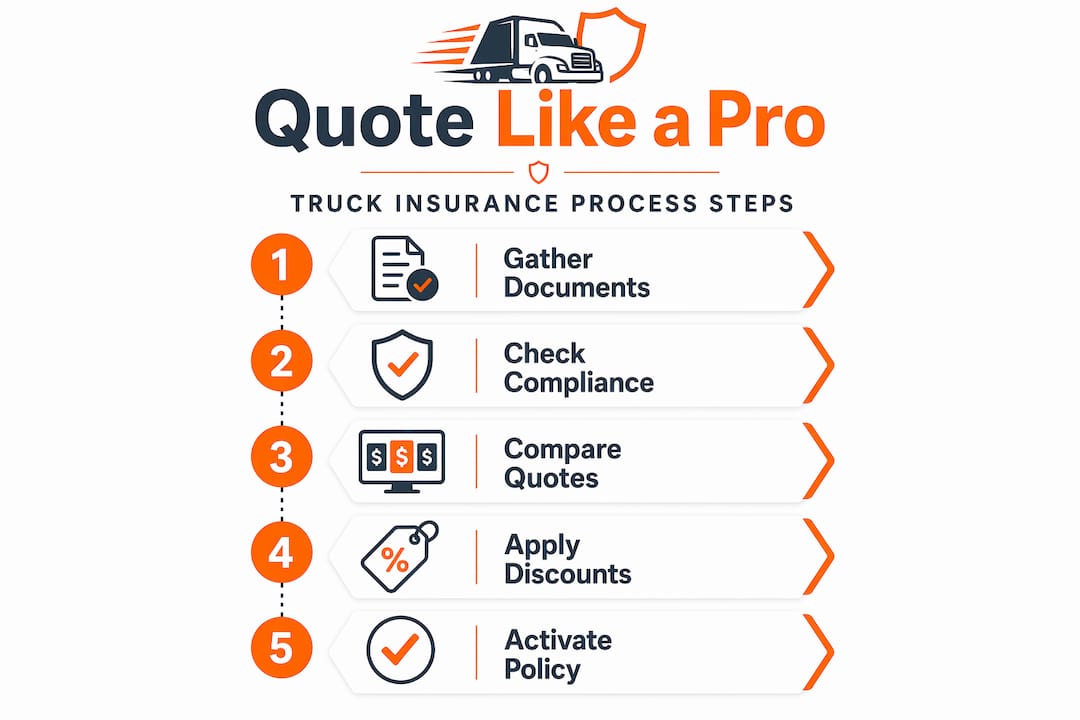
Here is the step-by-step quoting process:
Gather all documents — Compile DOT/MC numbers, VINs, MVRs, loss runs, cargo details, and CSA scores before contacting any agent
Identify trucking-specialized agents — Look for independent agents or brokers who focus specifically on commercial trucking, not general commercial lines
Request three to five quotes — More quotes mean more data points and more negotiating leverage
Compare apples to apples — Match each quote on the same liability limits, deductibles, and endorsements before comparing price
Check exclusions carefully — A cheaper policy with broad exclusions can leave you exposed in exactly the situation you thought you were covered for
Ask about technology discounts — Telematics systems, dashcams, and electronic logging devices can reduce premiums by 15 to 25% with many carriers
Set a renewal review date — Put a calendar reminder 90 days before your renewal so you never get caught auto-renewing
Pro Tip: Leased-on owner-operators should ask their motor carrier what coverage the carrier’s policy already provides before purchasing their own. Duplicate coverage wastes money, and gaps in coverage between the two policies create real risk.
Additional ways to unlock discounts include:
Completing voluntary safety training programs recognized by your insurer
Maintaining a clean CSA score in all seven FMCSA Behavior Analysis and Safety Improvement Categories (BASICs)
Bundling physical damage coverage with your liability policy under one carrier when pricing supports it
Paying your annual premium upfront rather than monthly, which many carriers reward with a discount
Learn how insurance brokers save fleets time and money through carrier access and negotiation. For a broader look at fleet cost reduction, there are proven strategies worth reviewing before your next renewal. You can also read a focused breakdown on getting the best quotes for additional tactical guidance.
Common mistakes, cost pitfalls, and how to future-proof your quoting
Even diligent quoting can fall short unless you proactively address rising risks and industry changes. The trucking insurance market in 2026 is more volatile than it has been in years, and operators who do not stay current pay for it.
Rising costs in 2026 are driven by nuclear verdicts reaching record highs above $100 million, the outdated $750,000 federal minimum that has not changed since 1985, and aggressive litigation in California, Florida, and Texas. Fleets that mitigate these risks through safety technology and low CSA scores gain a measurable pricing advantage.
The most common and costly quoting mistakes include:
Auto-renewing without shopping — Carriers often raise rates at renewal knowing many operators will not shop. Even a 10% rate increase on a $50,000 fleet premium is $5,000 left on the table.
Relying on a single quote — One quote tells you nothing about the market. Three to five quotes reveal what your operation is actually worth to different carriers.
Ignoring exclusions — Policies with lower premiums sometimes exclude specific cargo types, certain routes, or driver categories. Read every exclusion before signing.
Carrying outdated limits — Running at the $750,000 federal minimum in a nuclear verdict environment is a serious financial risk. Many attorneys target trucking companies specifically because of perceived insurance depth.
Not reviewing after major changes — Adding a truck, hiring a new driver, or changing cargo types all affect your risk profile and should trigger a mid-term review.
“The $750,000 federal minimum set in 1985 represents a fraction of its original purchasing power today. A single nuclear verdict can exceed that limit by a factor of 100 or more, leaving the carrier personally exposed.”
State differences matter too. Operating in New York or California versus Maine or Montana is not the same risk environment. High-litigation states carry higher base rates, and some carriers restrict their appetite in those states entirely. Knowing your exposure by state helps you ask better questions when comparing quotes.
Safety technology is one of the most effective tools for controlling future costs. Dashcams reduce fraudulent claims. Telematics data can exonerate your driver in an accident. Both signal to insurers that your fleet is managed proactively, which translates directly into lower multipliers. Review proven cost reduction strategies and stay current with trucking industry updates as the market continues to shift.
Our take: Why quoting smart matters more than ever in 2026
Here is the uncomfortable truth about truck insurance quoting: most operators spend more time negotiating fuel contracts than they do reviewing their coverage. A 2-cent-per-gallon fuel saving gets celebrated. A $4,000 annual overpayment on insurance gets ignored because it is invisible.
The fleets that consistently pay less for better coverage share one habit. They treat insurance as an active business decision, not an annual administrative task. They shop early, use independent agents who can access 10 to 20 carriers, and they know their risk profile well enough to explain it confidently to an underwriter.
Complacency is the real cost driver. Auto-renewal is the mechanism. When you let a policy roll over without comparison shopping, you are handing your carrier a price increase with no resistance. The market has changed significantly in the past three years, and your rate should reflect that.
The biggest gains come from three places. First, working with broker advantages that give you carrier access you cannot get on your own. Second, investing in safety technology that reduces your risk multiplier before you even start quoting. Third, reviewing your coverage whenever your operation changes, not just at renewal.
One more thing worth saying directly: the $750,000 federal minimum is a trap for operators who assume compliance equals protection. It does not. In today’s litigation environment, that limit can be exhausted in a single serious accident before attorney fees are even calculated. Carrying higher limits is not just good practice. It is financial self-defense.
Simplify your quoting process with Insuaria
Organizing the documents and details required for an accurate truck insurance quote takes time, and missing even one item can delay your coverage or inflate your rate.
Insuaria is a compliance-first intake and referral platform built to help truck owners and fleet managers organize exactly the information licensed insurance professionals need to review your coverage. Through simple intake forms and educational resources, you can start your trucking intake and submit your details in one organized place before a licensed agency partner follows up. If you also need to review personal auto or business insurance, Insuaria supports those processes too. Insuaria does not provide quotes or bind coverage. Licensed professionals handle that. We just make the first step faster and less frustrating.
Frequently asked questions
What documents do insurers require for truck insurance quotes?
Insurers require DOT/MC numbers, VINs, driver MVRs, loss runs, cargo details, and CSA scores to assess risk and price your policy accurately.
How much does commercial truck insurance cost in 2026?
Owner-operators pay $8,000 to $15,000 per year per truck, fleets pay $6,000 to $12,000 per truck, and new authorities are 20 to 40% higher than established carriers.
What are FMCSA minimum liability coverage requirements?
FMCSA requires $750,000 for general freight, $1 million for oil and non-bulk hazmat, and up to $5 million for high-risk hazmat loads.
How can fleets lower their insurance premiums?
Fleets can use telematics and dashcams for 15 to 25% discounts, compare three to five quotes from specialists, and maintain low CSA scores to reduce their risk multipliers.
Why are truck insurance premiums rising in 2026?
Premiums are rising due to nuclear verdicts exceeding $100 million, aggressive litigation in California, Florida, and Texas, and a federal minimum liability limit that has not been updated since 1985.
Recommended
Comments