How an organized workflow speeds up insurance quotes
- Guyorguy Laguerre
- May 8
- 11 min read


TL;DR:
Getting insurance quotes can involve delays and inconsistencies when information is incomplete or variable requests are made.
A structured, consistent approach to gathering and submitting accurate data streamlines the process, reduces errors, and enables fair comparisons.
Getting insurance quotes sounds simple until you’re three calls deep, you’ve repeated your home’s square footage twice, and you still don’t have a number you can actually use. The back-and-forth is frustrating, the results are inconsistent, and by the end, you’re not even sure you’re comparing the same coverage. The good news is that most of this friction is preventable. A structured, consistent approach to requesting quotes saves time, reduces errors, and gives licensed insurance professionals exactly what they need to help you faster. This article walks you through every step.
Table of Contents
Preparation: Gather essential information before requesting quotes
Step-by-step insurance quote request workflow for auto, home, life, and business
Avoiding common pitfalls: Ensuring accurate quote comparisons
Organizing and presenting your quotes for clear decision-making
Take the next step: Streamline your insurance quote workflow with Insuaria
Key Takeaways
Point | Details |
Prepare all inputs | Gather documents and key info before starting for faster, error-free insurance quotes. |
Follow workflow steps | Request insurance quotes by sticking to a step-by-step process for each category. |
Compare apples-to-apples | Keep coverage settings consistent to make quotes genuinely comparable. |
Organize your quotes | Present and group quotes for clarity, leading to more confident decision-making. |
Leverage digital tools | Digital intake and automation can streamline submissions and speed up results. |
Preparation: Gather essential information before requesting quotes
Most delays in the insurance quote process aren’t caused by complicated coverage decisions. They happen because the right information isn’t ready when it’s needed. A licensed professional can only work with what you give them, and if your details are scattered or incomplete, the process stalls.
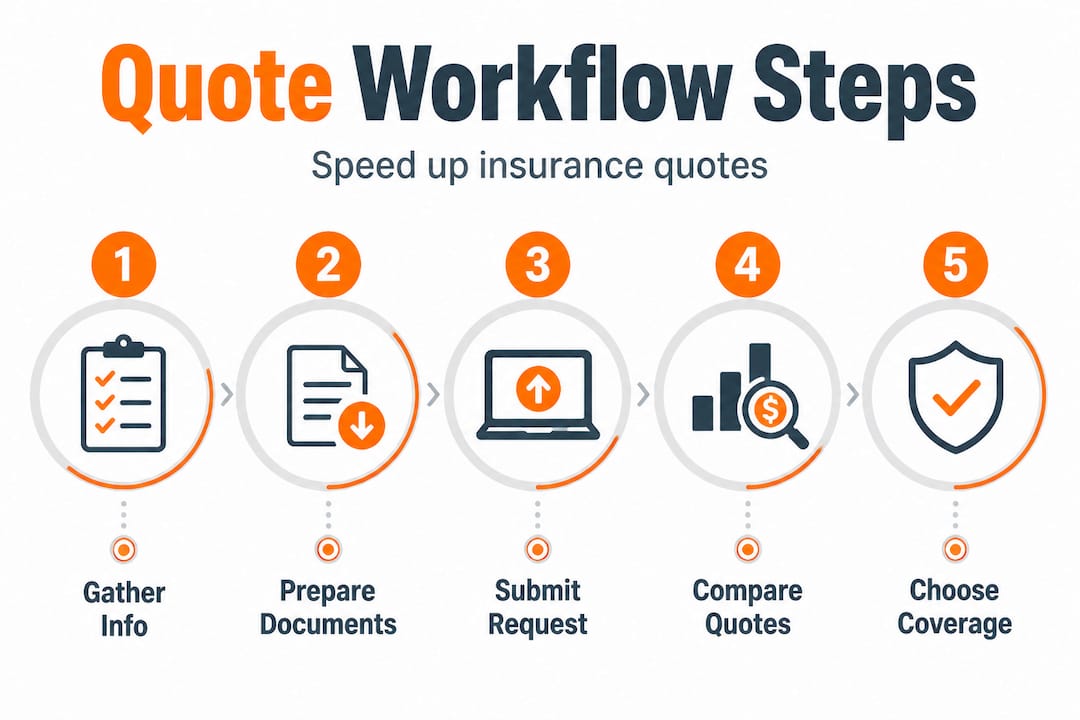
Quote accuracy improves significantly when you assemble a consistent baseline of inputs before you start comparing. Think of it the same way you’d think about filing taxes. You wouldn’t sit down at the computer without your W-2, and you shouldn’t request insurance quotes without your vehicle identification number, property details, or prior policy documents.
What to gather for auto insurance
For auto coverage, you’ll want to pull together:
Full legal names and dates of birth for all drivers in the household
Driver’s license numbers for each driver
Vehicle details: year, make, model, trim level, and VIN (Vehicle Identification Number)
Current odometer reading and estimated annual mileage
Prior insurance company name, policy number, and expiration date
Any at-fault accidents or moving violations in the last three to five years
Desired coverage limits (liability, collision, comprehensive) and deductible preferences
What to gather for home insurance
For homeowners coverage, the list looks different:
Property address and legal description if available
Year the home was built, square footage, and construction type (wood frame, brick, etc.)
Roof age and material
Prior insurance company and claims history for the last five years
Desired dwelling coverage amount and personal property limits
Any safety features: alarm systems, fire sprinklers, storm shutters
What to gather for life insurance
Life insurance requires more personal detail because it involves underwriting, which is the process of assessing your health risk. Prepare:
Full legal name, date of birth, and Social Security number
Driver’s license number
Contact information and beneficiary details
Health history: diagnosed conditions, medications, surgeries, family medical history
Lifestyle factors: tobacco use, alcohol consumption, hobbies that carry physical risk
Desired coverage amount and policy type (term vs. permanent)
What to gather for business insurance
Business owners and operators need a separate set of inputs. Quote checklists for business coverage drive more accurate pricing and reduce back-and-forth with professionals. For a complete checklist for business insurance, especially for trucking operations, you’ll want:
Business legal name and entity type (LLC, corporation, sole proprietorship)
Federal Employer Identification Number (EIN) or SSN for sole proprietors
Industry classification and primary business activities
Number of employees and annual payroll
Business revenue and years in operation
Driver information for commercial auto: MVR (Motor Vehicle Record), CDL number if applicable
Prior claims history and current coverage details
Budget range for monthly or annual premiums
Data table: Inputs needed by insurance type
Insurance type | Personal ID | Vehicle info | Property info | Health history | Business info | Prior policy |
Auto | Yes | Yes | No | No | No | Yes |
Home | Yes | No | Yes | No | No | Yes |
Life | Yes | No | No | Yes | No | No |
Business | Yes | Yes (commercial) | Sometimes | No | Yes | Yes |
Pro Tip: Scan or photograph all relevant documents and save them in a labeled folder before you begin. Having your insurance card, vehicle registration, mortgage documents, and prior policy declarations page in one place cuts the preparation time in half and prevents the need for follow-up calls.
Step-by-step insurance quote request workflow for auto, home, life, and business
Once your documents are organized, the actual workflow for requesting quotes follows a logical sequence. Each insurance type has a slightly different path, but they all start in the same place: with accurate, complete information.
Auto and home insurance workflow
Compile your data using the checklist from the preparation section above. Double-check vehicle identification numbers and property addresses for typos, since even one wrong digit changes the quote.
Choose your submission method. You can go directly to a carrier’s website, use an independent agent, or submit through an intake platform that routes your information to licensed professionals.
Enter consistent information. Use the same deductible, the same liability limit, and the same coverage details for every quote you request. This is the single most important step for a fair comparison.
Request quotes from at least three sources to get a meaningful range of pricing.
Record each quote with the carrier name, coverage details, premium amount, and any notable exclusions or endorsements.
Follow up if you don’t hear back within 24 to 48 hours. Licensed professionals are busy, and a brief check-in keeps your request from getting buried.
Life insurance workflow
Life insurance quoting works a bit differently. Online estimates for life insurance are just that: estimates. The real number doesn’t come until a licensed professional reviews your full application and health details go through underwriting.
Gather all health and lifestyle information before starting any online forms.
Complete the intake form as accurately as possible. Errors here can delay the process or cause a quote to change dramatically after underwriting.
Understand that the initial number is a preliminary estimate.
Be prepared to provide additional documentation, such as medical records or pharmacy history, during the formal application process.
Compare estimates from multiple carriers before committing to a full application.
Business insurance workflow
The business insurance quoting process starts with choosing your channel, setting a budget, gathering coverage information, and then following your selected path to a licensed professional. For trucking operations, the steps in truck insurance quote steps and understanding the commercial truck insurance process add additional layers, including USDOT numbers, cargo type, and operating radius.
Define your budget range. Know what you can realistically spend before comparing options.
Identify required coverages. Some are mandated by law (workers’ compensation in most states, commercial auto liability for licensed carriers). Others depend on your lease agreements, contracts, or industry standards.
Gather all team and risk information. This includes driver lists, payroll figures, revenue, and any subcontractors you regularly use.
Choose your channel. Marketplace comparison sites, direct carrier portals, independent agents, or intake platforms each have different strengths.
Submit your information and follow up within 48 to 72 hours.
Comparison table: Workflow by insurance type
Step | Auto | Home | Life | Business |
Gather personal ID | Yes | Yes | Yes | Yes |
Gather asset or health info | Vehicle details | Property specs | Health history | Employees, revenue |
Choose submission method | Carrier, agent, platform | Carrier, agent, platform | Carrier, agent | Agent, marketplace |
Initial quote type | Usually instant | Usually instant | Estimate only | Requires agent review |
Follow-up needed | Sometimes | Sometimes | Almost always | Almost always |
Underwriting required | Minimal | Minimal | Yes | Yes |
Pro Tip: If you’re requesting bundled quotes (for example, auto and home together), review the combined coverage carefully and track the policy activation dates separately. Bundled discounts can be valuable, but the policies don’t always start on the same date, and a gap in one can affect the other.
Avoiding common pitfalls: Ensuring accurate quote comparisons
Comparing insurance quotes sounds straightforward. In practice, it’s one of the easiest places to make a mistake that costs you money or leaves you underinsured.
The most common error is changing variables from one quote to the next. A $500 deductible versus a $1,000 deductible can make one quote look significantly cheaper even if the coverage is identical otherwise. Quotes appear cheaper when they reflect lower coverage limits or higher deductibles, not necessarily better pricing. Keeping variables consistent is the only way to compare apples to apples.
Mistakes to avoid when comparing quotes
Changing deductibles between quotes. Stick to one amount for all quotes you’re comparing.
Requesting different liability limits. If you request $100,000 in liability from one carrier and $250,000 from another, the prices are not comparable.
Omitting claims history. Leaving out an accident or claim may produce a quote that won’t survive underwriting review.
Using different addresses or ZIP codes. Even a neighboring ZIP code can meaningfully affect pricing for home and auto.
Forgetting to include all drivers. An unlisted household driver is a major underwriting red flag.
Relying only on premium. Monthly cost is one data point. Policy exclusions, coverage sublimits, and claims handling reputation matter just as much.
Not reviewing declarations pages. The declarations page (often called the “dec page”) is the summary of your coverage. Read it before signing.
“Home and car quotes are highly sensitive to address and coverage inputs. Use identical settings across every quote to produce a meaningful comparison.”
The impact of inconsistency is more significant than most people realize. Quote estimates can vary by more than 25% simply because a ZIP code or deductible was entered differently. That’s not a carrier offering a better rate. That’s a different product being priced.
Reviewing quotes line by line takes time, but it’s the only way to know what you’re actually buying. Look at each coverage section: liability limits, property damage limits, deductible amounts, exclusions, and any optional riders or endorsements. If a quote looks unusually low, the reason is almost always in those details.
For business owners trying to lower commercial insurance costs, this step is especially critical. Commercial policies carry more variables, more exclusions, and more potential for coverage gaps than personal lines policies.
Organizing and presenting your quotes for clear decision-making
Once you have three or more quotes in hand, the work shifts from gathering to organizing. Many people skip this step, and it’s a mistake. Unorganized quotes lead to confusion, second-guessing, and slower decisions.
Here’s a practical approach:
Create a dedicated folder for each insurance type you’re quoting. Use digital folders labeled “Auto Quotes 2026,” “Home Quotes 2026,” and so on. Print copies if you prefer paper.
Build a simple spreadsheet. Columns should include: carrier name, monthly premium, annual premium, deductible, liability limits, key exclusions, and any notable endorsements.
Highlight your preferred option in the spreadsheet using a color code. Green for your top pick, yellow for strong alternatives, red for options you’re likely to eliminate.
Write a brief summary of why each option ranks where it does. This doesn’t have to be formal. Even three bullet points per quote helps clarify your thinking.
Prepare your questions for the licensed professional who will finalize or bind coverage. What isn’t clear? What’s different about your top pick versus the second choice?
Organizing quotes clearly, leading with context and your preferred option while showing alternatives, reduces confusion and makes it easier for everyone involved to reach a confident decision. When a licensed professional receives organized, contextualized information, they can advise you faster and more accurately.

Pro Tip: Use one spreadsheet row per quote and lock in the same comparison fields for every entry. Inconsistent rows are just as confusing as inconsistent quotes. A clean spreadsheet you built yourself will do more for your decision-making than any comparison tool that changes the variables for you.
The goal of organizing your quotes isn’t to do the licensed professional’s job for them. It’s to give them a clear picture so they can do their job faster and better. When you submit organized, well-labeled information through a platform like streamlining quote workflow, the turnaround from intake to professional response improves noticeably.
For trucking businesses or commercial operators, using a dedicated trucking quote submission process adds an additional layer of structure that standard intake forms don’t provide.
What most guides miss about insurance quote workflows
Most articles about getting insurance quotes focus almost entirely on price. Compare costs, find the lowest number, move on. That advice isn’t wrong, but it’s incomplete, and it causes more problems than it solves.
The real inefficiency in the insurance quote process isn’t overpaying for coverage. It’s wasted time. Every time you request a quote with incomplete information, you create a loop: the professional asks a follow-up question, you find the document, you respond, they re-run the quote. That loop can repeat three or four times per quote request and across multiple carriers. Multiply that by four insurance types and a busy household or business, and you’re looking at days of back-and-forth that could have been avoided in an afternoon of preparation.
Quote bottlenecks come from manual entry. Pre-populating and validating information before it reaches the professional eliminates the most common source of delay. This is the insight that automation and digital intake platforms are built around, and it’s genuinely undervalued in most consumer-facing guides.
Here’s what insurance broker workflow tips consistently show: licensed professionals respond faster and produce better outcomes when the intake information is organized, accurate, and complete. It’s not that they can’t work with messy data. It’s that your organized submission immediately signals you’re a serious, prepared client. That dynamic changes the conversation.
The second thing most guides miss is the value of digital organization as a long-term habit, not a one-time project. Insurance isn’t static. You’ll add a driver, move to a new home, start a business, or need to adjust your life insurance coverage. Every one of those events triggers a new quote process. Families and business owners who maintain a living document with their insurance details, updated annually or after major life events, cut future quote request time by more than half.
Using digital workflow improvements doesn’t have to mean sophisticated software. A shared folder, a spreadsheet, and scanned documents stored in the cloud is more than enough infrastructure for most households. What matters is consistency and the habit of updating it.
Pro Tip: After any major life event (new vehicle, home purchase, marriage, new employee, accident), update your insurance document folder the same week. Don’t wait until the next renewal. Your current coverage may already need adjusting, and an updated file means your next quote request takes minutes, not hours.
Take the next step: Streamline your insurance quote workflow with Insuaria
Reading this article is the first step. The next one is putting the workflow into practice without starting from scratch.
Insuaria is built specifically for this moment. We’re a compliance-first intake and referral platform that helps individuals, families, trucking businesses, and business owners organize the information licensed professionals need to review their coverage. Our simple intake forms guide you through the exact details covered in this article, so nothing gets missed and nothing gets repeated. Whether you’re ready to request an auto insurance quote request, a home insurance quote request, a life insurance quote request, or a business insurance quote request, Insuaria makes the first step organized, efficient, and straightforward. Licensed professionals follow up after you submit. No guesswork, no cold calls, no repeated forms.
Frequently asked questions
What information should I prepare for an accurate auto insurance quote?
Have your driver’s license, vehicle registration, prior policy information, ZIP code, and desired coverage details ready before you start. A complete checklist like this drives more accurate pricing and reduces back-and-forth with licensed professionals.
How can I make sure insurance quote comparisons are truly fair?
Keep coverage limits, deductibles, and all other variables identical across every quote you request. Quotes that appear cheaper often reflect lower limits or higher deductibles rather than better value.
What’s the best workflow for requesting business insurance quotes?
Start by choosing your channel, setting a realistic budget, and gathering all relevant business and risk information before you contact anyone. Business insurance quoting works best when you follow this sequence before starting the actual quoting path.
Will the initial life insurance quote match the final premium?
No. Online life insurance quotes are preliminary estimates only, and the actual premium often changes after underwriting review of your full application and health details.
What mistakes should I avoid when requesting insurance quotes?
Avoid changing deductibles, coverage limits, or other variables between quotes, and never omit claims history or household drivers. Changing multiple variables makes it impossible to produce a fair, side-by-side comparison.
Recommended
Comments