The Role of Insurance in Logistics: 2026 Guide
- Guyorguy Laguerre
- 24 hours ago
- 10 min read


TL;DR:
Insurance in logistics safeguards goods, assets, and operations from loss, damage, theft, and liabilities across the supply chain. Without dedicated coverage like cargo, liability, and professional insurance, companies face significant uninsured risk, as carrier liability caps are often insufficient. Embedding insurance into TMS workflows enhances efficiency and reduces coverage gaps, while understanding policy exclusions and proper documentation are crucial for successful claims.
Insurance in logistics is the financial safeguard that protects goods, assets, and operations from loss, damage, theft, and liability throughout the supply chain. Without it, a single incident — a warehouse fire, a container lost at sea, a driver error — can erase a company’s annual profit margin in one claim. The role of insurance in logistics extends far beyond compliance. It is the structural backbone of logistics risk management, enabling companies to move freight confidently, satisfy lender requirements, and recover quickly when things go wrong. This guide breaks down every layer of that protection for logistics managers who need clarity, not theory.
What types of insurance are essential in logistics operations?
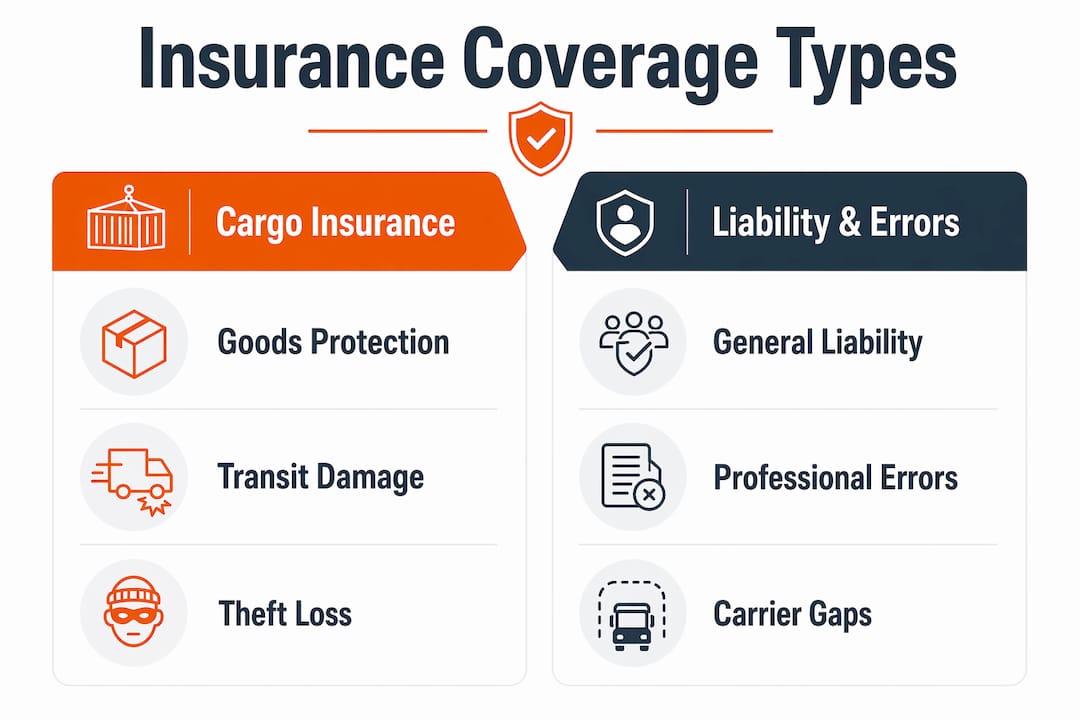
Logistics insurance is the collective term for several distinct coverage products that together address the full spectrum of risk in freight movement and supply chain operations. Logistics companies commonly maintain general liability, warehouse legal liability, and errors and omissions insurance alongside cargo coverage to manage both operational and third-party risks. Each product covers a different failure point, and gaps between them are where claims get denied.

Cargo insurance covers physical loss or damage to goods in transit, whether by road, rail, sea, or air. It responds to perils like collision, fire, theft, and water damage, and it travels with the shipment rather than the vehicle. More than 80% of international trade moves by sea, and financial institutions routinely require proof of cargo insurance before approving trade financing. That requirement alone makes cargo coverage non-negotiable for any logistics operation with international exposure.
General liability insurance protects your business when third parties claim bodily injury or property damage caused by your operations. If a forklift operator damages a client’s facility during a delivery, general liability responds. Warehouse legal liability insurance is a narrower product that covers goods while they are in your custody, care, and control inside a storage facility. It does not cover the building itself or your own equipment. It covers the client’s goods for which you are legally responsible.
Errors and omissions (E&O) insurance, sometimes called professional liability, covers financial losses that arise from mistakes in professional services. For a third-party logistics provider (3PL) that manages routing, customs brokerage, or freight forwarding, a documentation error that causes a shipment delay or customs penalty can trigger a client lawsuit. E&O insurance covers the legal defense and any resulting settlement.
The table below shows how these four coverage types differ in scope:
Coverage type | What it protects | Typical trigger |
Cargo insurance | Goods in transit | Physical loss or damage during movement |
General liability | Third-party bodily injury or property damage | Operational accident at client site |
Warehouse legal liability | Client goods in your custody | Damage or loss while stored at your facility |
Errors and omissions | Financial loss from professional mistakes | Routing error, documentation failure, missed deadline |
Why carrier liability falls short of real protection
Carrier liability is the default legal obligation a carrier holds for goods in its care, and it is not insurance. It is a contractual cap defined by international conventions like Hague-Visby for ocean freight and the Carmack Amendment for domestic trucking. Those caps are set far below the commercial value of most modern freight. Carrier liability caps pay as little as $2 per kilogram, often leaving 70 to 95 percent of a cargo’s commercial value uninsured. For a pallet of electronics or pharmaceuticals, that gap is catastrophic.
Carriers also have legal defenses that allow them to reduce or eliminate their liability entirely. Acts of God, inherent vice of the goods, improper packaging by the shipper, and public enemy clauses are all recognized defenses under most jurisdictions. A carrier that successfully argues any one of these pays nothing, regardless of the loss amount. Relying on carrier liability alone is not a risk management strategy. It is a gamble.
The practical consequences for logistics managers are direct:
A shipment of consumer electronics worth $500,000 covered only by carrier liability at $2 per kilogram on a 2,000-kilogram load yields a maximum payout of $4,000.
A carrier invoking an “inherent vice” defense on a spoiled food shipment can walk away from the claim entirely.
Subrogation rights against a carrier are limited by those same caps, so even if you recover from your own insurer, the insurer’s ability to recoup from the carrier is constrained.
Pro Tip: Review your cargo insurance coverage against the actual declared value of every shipment category you move. If the gap between carrier liability limits and commercial value exceeds your risk tolerance, dedicated cargo insurance is not optional.
Cargo insurance is profit protection. A single uninsured total loss on a high-value shipment can wipe out months of operating margin. That framing matters because it shifts the conversation from “cost of insurance” to “cost of not having insurance.”
How does embedding insurance into TMS improve logistics efficiency?
The administrative burden of managing insurance across a fleet of vehicles and hundreds of shipments per week is one of the most underestimated operational costs in logistics. Manually checking coverage, issuing certificates, and reconciling policies against shipment records consumes hours that could go toward freight optimization. The 2026 industry trend of embedding insurance directly into Transportation Management Systems (TMS) addresses this by making coverage a built-in function of the freight workflow rather than a separate administrative task.
Here is how TMS-integrated insurance works in practice:
Real-time quoting at booking. When a dispatcher creates a shipment record in the TMS, the system pulls cargo value, route, and commodity data and returns an insurance quote in seconds. The dispatcher accepts or adjusts coverage without leaving the platform.
Automatic binding. Once a shipment is confirmed, coverage binds automatically. No separate policy application, no email to a broker, no manual certificate generation. The shipment record and the insurance certificate are the same document.
Centralized claims initiation. When a loss occurs, the TMS already holds the Bill of Lading, delivery records, and shipment photos. The claims file is pre-populated, reducing the time between incident and submission.
Audit trail for compliance. Every shipment has a timestamped coverage record. Compliance audits, lender requirements, and client certificate requests are answered from a single dashboard.
The operational benefit is not just speed. It is accuracy. Human error in manual insurance processes, such as entering the wrong cargo value or forgetting to bind coverage on a last-minute shipment, creates uninsured exposure that no one notices until a claim is filed. Embedded insurance eliminates that failure mode by making coverage automatic and conditional on shipment creation.
Pro Tip: When evaluating TMS platforms, ask specifically whether insurance is native to the workflow or requires a third-party integration. Native integrations have fewer data handoff errors and faster binding times, which matters when you are dispatching dozens of loads per day. Insuaria’s insurance intake process for fleet operators is built around this kind of organized, pre-submission workflow.
What exclusions and coverage gaps catch logistics managers off guard?
Policy language is where logistics insurance either delivers or fails. Most logistics managers understand what their policies cover in general terms. Far fewer have read the exclusions section carefully enough to know where coverage stops. Standard cargo insurance policies frequently exclude claims for unattended vehicle theft, temperature variation issues, and mysterious disappearance. These are not edge cases. They are among the most common loss scenarios in trucking and warehousing.
The most consequential exclusions to know:
Unattended vehicle clause. If a driver leaves the truck unattended and cargo is stolen, many policies will deny the claim unless the vehicle was locked and in a secured facility. A truck stop overnight stop can void coverage.
Temperature variation. Reefer breakdowns and temperature excursions during transit are often excluded unless the policy specifically includes temperature-controlled cargo coverage. Standard cargo policies do not cover spoilage from mechanical failure.
Mysterious disappearance. If cargo is missing with no evidence of theft or damage, many policies exclude the claim. No police report, no forced entry evidence, no coverage.
War risk and geopolitical events. Standard marine policies exclude war, strikes, and civil commotion. War risk coverage is now necessary not just for ocean transit but for inland legs as well, given current geopolitical disruptions and supply chain rerouting through conflict-adjacent territories.
Multi-modal shipments create an additional coverage gap that is easy to miss. A marine policy covers ocean transit. It does not automatically extend to the truck leg from the port to the warehouse. Marine policies usually do not cover inland shipment legs without specific multi-modal endorsements. If your freight moves from a vessel to a rail car to a truck before final delivery, you need to confirm that each leg is explicitly covered.
Documentation is the other half of claim success. Cargo insurance claims depend heavily on the quality of documentation submitted, including the Bill of Lading, proof of delivery with noted exceptions, photos taken at the time of loss, and seal records. A claim submitted without a signed POD noting damage at delivery is a weak claim. A claim submitted with timestamped photos, a completed exception report, and a signed BOL is a strong one.
Documentation item | Why it matters for claims |
Bill of Lading | Establishes what was shipped, quantity, and condition at origin |
Proof of delivery with exceptions | Confirms damage was noted at delivery, not discovered later |
Timestamped photos | Provides visual evidence of loss or damage at the time of incident |
Seal records | Demonstrates whether cargo was tampered with during transit |
Pro Tip: Train drivers to document claims evidence at the point of delivery, not after returning to the terminal. Photos taken hours later, after cargo has been moved or handled further, carry far less weight in a claim dispute.
Key takeaways
Insurance in logistics protects profit, not just cargo. Without dedicated coverage across cargo, liability, and professional services, a single incident can exceed what carrier liability pays by a factor of 100 or more.
Point | Details |
Carrier liability is not enough | Caps as low as $2 per kilogram leave up to 95% of cargo value uninsured. |
Four coverage types are core | Cargo, general liability, warehouse legal liability, and E&O each cover distinct risk areas. |
TMS integration reduces exposure | Embedding insurance into dispatch workflows eliminates uninsured shipments caused by human error. |
Exclusions are where claims fail | Unattended vehicle, temperature variation, and mysterious disappearance clauses deny common loss scenarios. |
Documentation wins claims | Bill of Lading, delivery exceptions, and timestamped photos are the difference between paid and denied. |
Insurance as a competitive advantage, not a cost center
I have spent years watching logistics companies treat insurance as a line item to minimize rather than a tool to deploy. The companies that do it well think about coverage the way they think about fuel efficiency or driver retention. It is a variable that directly affects margin, client relationships, and the ability to grow.
The shift I find most significant right now is the move toward proactive, supply chain resilience framing. Insurance is no longer just about recovering from a loss. It is about being the logistics partner that clients trust to move sensitive, high-value freight because your risk management infrastructure is visible and credible. When you can show a client that every shipment is automatically insured at declared value, that your drivers are trained on documentation protocols, and that your claims history is clean, you are not just selling capacity. You are selling certainty.
The operators I have seen struggle are the ones who buy the cheapest policy available and assume it covers everything. They find out about the unattended vehicle clause when a claim is denied. They discover the multi-modal gap when a rail leg loss falls outside their marine policy. The cost of that education is always higher than the cost of getting the coverage right the first time.
My honest advice: treat your insurance requirements review as a quarterly operational task, not an annual renewal checkbox. Freight lanes change, commodity values shift, and geopolitical risks reroute supply chains faster than annual policy cycles can track. The logistics managers who stay ahead of those changes are the ones whose operations survive the incidents that put their competitors out of business.
— Guyorguy
Get your logistics insurance organized with Insuaria
Managing insurance across a fleet and multiple coverage lines is complex. Insuaria simplifies the first step by helping fleet operators and logistics businesses organize the information licensed insurance professionals need to review their coverage.
Through Insuaria’s business insurance intake process, you submit your fleet details, cargo types, and operational information in one place. A licensed agency partner then follows up with coverage options suited to your operation. There is no guesswork, no back-and-forth over missing details, and no shipment left without a coverage review. If you manage freight and want a cleaner, faster path to getting your coverage in front of the right professionals, Insuaria is built for exactly that.
FAQ
What is logistics insurance?
Logistics insurance is a group of coverage products, including cargo insurance, general liability, warehouse legal liability, and errors and omissions insurance, that protect goods, assets, and operations throughout the supply chain. It covers financial losses from damage, theft, liability claims, and professional errors during freight movement and storage.
Why is carrier liability not sufficient for cargo protection?
Carrier liability caps, set by conventions like Hague-Visby, pay as little as $2 per kilogram, which can leave 70 to 95 percent of a cargo’s commercial value uninsured. Carriers also have legal defenses that allow them to deny claims entirely, making dedicated cargo insurance the only reliable protection.
What are the most common reasons cargo insurance claims are denied?
The most frequent denial triggers are the unattended vehicle clause, temperature variation exclusions, and mysterious disappearance clauses. Claims are also weakened or denied when documentation such as the Bill of Lading, delivery exceptions, and photos is incomplete or submitted late.
How does TMS integration improve insurance coverage in logistics?
Embedding insurance into a Transportation Management System automates quoting, binding, and certificate generation at the point of shipment creation. This eliminates the human error of forgetting to bind coverage and creates a built-in audit trail for every load.
Does a standard marine policy cover all legs of a multi-modal shipment?
No. Marine policies typically cover only the ocean transit leg. Inland truck and rail legs require specific multi-modal endorsements to be covered. Without those endorsements, a loss during the land portion of a shipment may not be covered at all.
Recommended
Comments