Cargo insurance coverage: an essential guide for trucking
- Guyorguy Laguerre
- May 5
- 12 min read


TL;DR:
Many trucking operators mistakenly believe cargo insurance is only a legal requirement, but market demands and contract obligations often impose higher coverage needs.
Cargo insurance protects against loss or damage to goods in transit, but policies vary widely in coverage, exclusions, and endorsements; understanding these details is crucial.
Proper documentation and regular policy reviews are essential to ensure coverage matches operational risks, especially for high-value or specialized freight.
Most trucking business owners assume that cargo insurance is simply a legal requirement, something the Federal Motor Carrier Safety Administration (FMCSA) demands before you roll a single mile. The reality is more nuanced, and misunderstanding it can cost your business far more than a missed premium payment. The FMCSA only requires cargo insurance for household goods carriers, setting minimums as low as $5,000 per vehicle and $10,000 per occurrence, while brokers and shippers routinely demand $100,000 or more for general freight. This guide cuts through the confusion, explaining exactly what cargo insurance covers, when you truly need it, and how to make sure your policy matches your real-world risk.
Table of Contents
Key Takeaways
Point | Details |
Federal requirement is rare | Federal law only requires cargo insurance for household goods carriers, not general freight operators. |
Contracts demand higher limits | Most brokers and shippers require $100,000 or more in cargo insurance, above legal minimums. |
Policy exclusions matter | Every policy has exclusions that can affect claim payouts—always review your policy in detail. |
Proper documentation is essential | Successful claims depend on having the right shipment records and detailed documentation. |
Tailored coverage protects your fleet | The right cargo insurance policy should fit your actual business risks, cargo types, and client requirements. |
What is cargo insurance coverage?
Cargo insurance is a specialized type of commercial coverage designed to protect the physical goods your trucks haul. When freight is lost, damaged, or stolen while in your care, cargo insurance steps in to cover the financial loss. Without it, your business absorbs that cost directly.
The goods you haul are often worth far more than the truck transporting them. A single refrigerated trailer loaded with electronics, pharmaceuticals, or specialty foods can carry a cargo value of $200,000 or more. Even a short-haul accident on a local route can lead to a total loss of freight, followed by a shipper or broker demanding payment. That kind of hit can threaten a small or mid-size fleet’s financial stability quickly.
Policies generally fall into two broad categories. The first is a named perils policy, which only covers losses caused by the specific risks listed in the policy document. If the cause of loss is not on that list, the claim is denied. The second is an all risk policy, which sounds broader and in many ways is. But even all risk policies come loaded with exclusions, conditions, and endorsements that limit coverage in ways you might not expect.
Understanding carrier insurance requirements before you buy is critical. Cargo insurance does not exist in isolation. It connects with your auto liability, physical damage, and general liability coverage to form a complete risk picture for your operation.
Key features of a standard cargo insurance policy include:
Coverage limit: The maximum dollar amount the insurer pays for a covered loss.
Deductible: The portion of the loss you pay before coverage kicks in.
Named perils vs. all risk form: Determines which causes of loss are covered.
Endorsements: Add-ons that extend coverage to specific commodities, transit methods, or situations.
Exclusions: The conditions or events the policy will not cover under any circumstances.
Pro Tip: Even policies labeled “all risk” carry significant exclusions. Before you sign, read every exclusion line by line. What looks like broad protection may have a specific carve-out for exactly the commodity you haul most.
This foundational understanding of what cargo insurance is sets the stage for a deeper look at what specific losses are actually covered.
What does cargo insurance actually cover?
Standard cargo insurance is built around a core set of covered perils. These are the situations where your insurer will generally step in and pay. However, a long list of exclusions runs alongside those covered perils, and knowing both sides of that equation is just as important as knowing your coverage limit.
Common covered events:
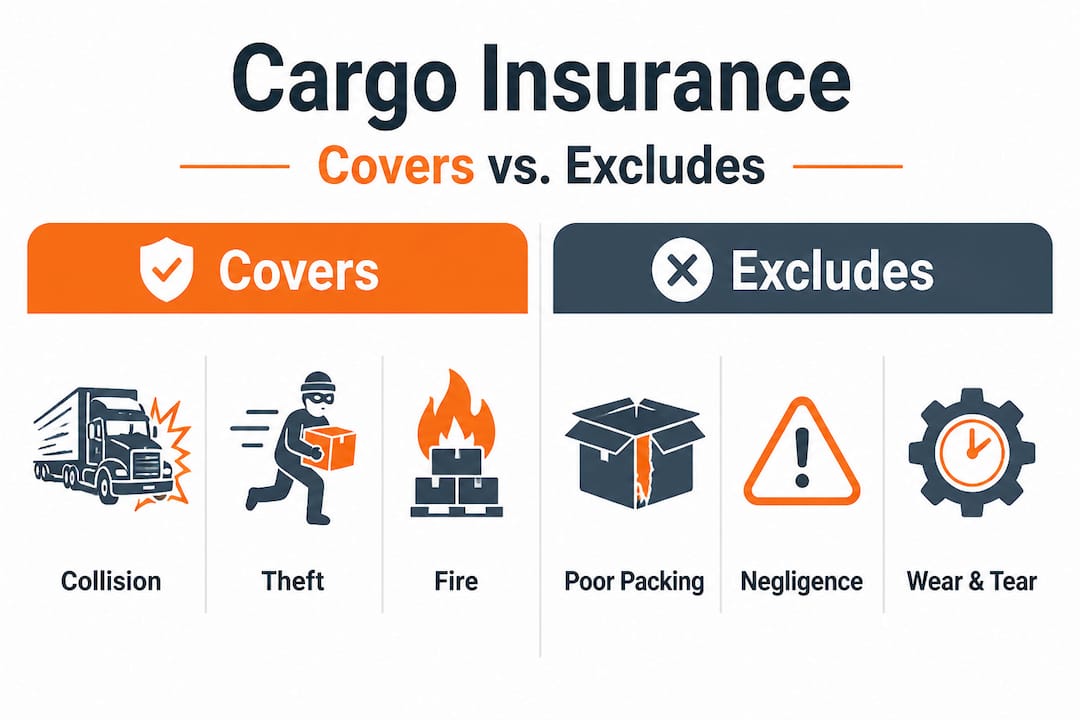
According to standard motor truck cargo forms, covered events typically include collision or overturn of the carrying vehicle, fire, theft under specified conditions, and certain weather-related events like windstorm or hail. Water damage from sources other than flood may also be included. Some policies extend to loading and unloading incidents or misdelivery under certain conditions.
What is typically excluded:
The exclusion list tends to catch carriers off guard. Here are the most common situations cargo insurance will not cover:
Wear and tear or gradual deterioration of goods.
Losses caused by improper packing or inadequate preparation by the shipper.
Certain high-value commodities such as art, jewelry, or currency unless specifically endorsed.
Owner negligence or willful misconduct.
Temperature damage on refrigerated loads unless a reefer breakdown endorsement is attached.
Infestation or contamination.
Consequential losses, meaning losses that result from the initial loss but are not the direct physical damage itself.
Covered events | Common exclusions |
Collision and overturn | Wear and tear |
Fire | Improper packing by shipper |
Theft (with conditions) | Owner negligence |
Certain weather events | Unlisted commodities |
Windstorm or hail | Temperature damage (without endorsement) |
Loading/unloading (some policies) | Infestation or contamination |
“Motor truck cargo insurance typically covers collision/overturn, fire, theft (with conditions), and certain weather events, often on named-perils or all-risk forms that are subject to exclusions and endorsements.” — FreightWaves
The table above shows that many losses truckers assume are covered simply aren’t. A shipper who poorly packs a load of fragile goods, and then blames the carrier when those goods arrive broken, may find the cargo claim denied because improper packing is excluded. That’s not an edge case. It happens regularly.
For insurance tips for trucking businesses, the most important habit is reading each policy section alongside an advisor who understands freight. Not a general business insurance agent. Someone who works with motor carriers specifically.
Refrigerated freight deserves special mention. Reefer loads are high-value and highly sensitive. A standard all risk cargo policy often excludes temperature-related spoilage unless you purchase a separate reefer breakdown endorsement. If you haul produce, meat, dairy, or temperature-sensitive pharmaceuticals, that endorsement isn’t optional. It’s essential.

Who needs cargo insurance and when is it required?
This is where many trucking professionals carry a dangerous misconception. Federal law, specifically FMCSA regulations, does not require most general freight carriers to hold cargo insurance. The FMCSA’s requirement applies specifically to household goods movers, where minimums are set at $5,000 per vehicle and $10,000 per occurrence. For general freight, there is no federal mandate.
That said, the absence of a federal requirement does not mean you can operate without cargo insurance. It means that the market itself enforces coverage requirements through contracts.
Who requires it | Typical minimum required |
FMCSA (household goods only) | $5,000 per vehicle / $10,000 per occurrence |
Freight brokers (general freight) | $100,000 minimum |
Shippers (high-value loads) | $250,000 or more |
Shippers (reefer/temp-controlled) | $250,000 or more |
Some shipper contracts (electronics, pharma) | $500,000 or more |
Steps to ensure you meet all coverage obligations:
Check your broker agreements. Every freight broker operating under a standard setup will include cargo insurance minimums in their carrier packet. Read it carefully before accepting loads.
Review shipper contracts directly. High-value shippers often have their own insurance addendums that override broker requirements. Read both.
Know your commodity’s value. The value of what you’re hauling should inform your coverage limit, not the other way around. If a single load is worth $300,000, a $100,000 policy leaves a $200,000 gap.
Ask before you book. Before accepting any new freight relationship, ask the broker or shipper what their minimum cargo insurance requirement is. This takes 30 seconds and can prevent serious problems.
Review annually as your business grows. Adding new lanes, new clients, or new commodities may increase your coverage needs. What worked two years ago may leave you exposed today.
Understanding where motor carrier regulatory obligations end and contractual obligations begin can protect your business from costly assumptions. The moment you sign a broker or shipper contract without the required coverage, you’re operating in a legally exposed position. And if a loss occurs before you discover that gap, the financial fallout can be severe.
Pro Tip: Never assume that meeting the federal minimum means you’ve satisfied your coverage obligations. Always ask clients directly what their minimum required cargo coverage is. The contractual bar is almost always higher than the legal one.
Operators hauling specialized commodities like art, wine, high-end electronics, or pharmaceuticals often find that standard market coverage doesn’t reach their exposure. Specialty carriers and program markets exist for these niches. Getting connected with a specialist rather than a generalist makes a measurable difference in how well your coverage fits your actual risk profile. Commercial trucking insurance built around your specific cargo type will always outperform a one-size-fits-all approach.
How do cargo insurance claims work?
Understanding coverage is only half the equation. When something goes wrong during a haul, how you respond in the first hours after a loss directly affects whether your claim is paid quickly, partially, or denied.
Here is a step-by-step breakdown of how a cargo insurance claim typically unfolds:
Secure the scene. If the loss involves a collision or theft, make the scene safe and do not move goods or equipment before documenting everything.
Photograph everything. Take photos of the vehicle, the cargo, the loading area, any damage, seal integrity, and the surrounding environment. More documentation is always better.
Note exceptions on the Proof of Delivery. When delivering damaged goods, exceptions must be noted on the Proof of Delivery (POD) at the time of delivery. If you don’t note it there, the insurer may argue the damage occurred before or after your custody.
Preserve the Bill of Lading. The Bill of Lading (BOL) is the foundational document for any cargo claim. Keep it accessible and accurate.
File a police report when applicable. Theft, hijacking, or vandalism requires a police report. Claims documentation requirements typically include police reports for theft-related losses.
Notify your insurer promptly. Most policies have a timely notice requirement. Waiting too long to report a loss can give the insurer grounds to deny the claim on procedural grounds.
Cooperate with the adjuster. Provide all requested documentation quickly. Delays caused by the insured are one reason claims drag on longer than necessary.
Documents you need for a successful cargo claim:
Signed Bill of Lading with accurate cargo description.
Proof of Delivery with exception notations.
Photographs of damaged goods and the scene.
Seal numbers and condition at loading and delivery.
Police report (for theft or vandalism).
Cargo value documentation such as invoices or purchase orders.
Driver’s incident report or statement.
“Cargo claims require documentation including the BOL, POD with exceptions, photographs, seals, and police reports where applicable. Common claim denials often stem from exclusions or failure to meet policy conditions.” — FreightWaves
Missing even one of these documents can result in a partial payment or a full denial. The most frustrating part for carriers is that these denials are often preventable. A missed exception on a POD, an undocumented seal number, or a delayed police report can torpedo a legitimate claim.
Working with experienced insurance brokers who specialize in trucking can help you build claims procedures into your daily driver operations before a loss happens. That kind of proactive setup costs very little but pays off significantly when it matters.
Pro Tip: Build a simple claims checklist into your dispatch process. Every driver should know the first five steps to take after an incident before they call anyone else. Speed and documentation quality in the first hour after a loss often determine how smoothly the claim resolves.
How to choose the right cargo insurance for your fleet
With so many policy options, cargo types, and coverage structures available, selecting the right cargo insurance can feel overwhelming. But if you break the decision into clear steps, it becomes manageable.
Step 1: Know your cargo. What you haul determines what coverage you need. Dry van loads have different risk profiles than reefer, flatbed, or specialized freight. List every commodity type your fleet currently hauls and any you expect to add in the next 12 months.
Step 2: Assess your maximum single-load value. What is the highest-value shipment you regularly carry? That number should be close to your minimum coverage limit. Carrying $100,000 in coverage when your average load is worth $180,000 creates a structural gap in your risk management.
Step 3: Compare named perils vs. all risk forms. Named perils is usually less expensive but covers fewer scenarios. All risk costs more but offers broader protection. For fleets hauling high-value or sensitive commodities, all risk is typically the more appropriate form, even accounting for its exclusions.
Step 4: Read every exclusion. Ask your advisor or prospective insurer to walk you through the exclusion list specific to your policy. Pay special attention to exclusions related to your commodity types, packing requirements, and any temperature or condition-sensitive freight you handle.
Step 5: Ask the right questions before buying:
Does this policy cover loading and unloading?
What happens if the driver is found negligent?
Are there exclusions for specific equipment types or trailer configurations?
What is the process for filing a claim, and what are the time requirements?
Does this policy meet my largest broker or shipper contract requirements?
Step 6: Review annually. As your business changes, your coverage should change too. Strategies to reduce trucking insurance costs while maintaining adequate coverage start with an annual policy review that ensures you’re not paying for coverage you don’t need or missing coverage you do.
Policy options worth considering:
Reefer breakdown endorsement for temperature-sensitive freight.
High-value commodity endorsement for electronics, pharmaceuticals, or luxury goods.
Unattended vehicle endorsement for routes where trailers may sit overnight at unsecured locations.
Loading and unloading coverage if your drivers regularly assist with freight handling.
Pro Tip: If you haul specialized or high-value commodities, don’t rely solely on a general insurance agent. Seek out an advisor who works specifically with motor carriers and understands the freight market. The coverage options on named-perils or all-risk forms can vary significantly between insurers, and a specialist will know which markets write the best programs for your specific cargo type.
The uncomfortable truth most fleet owners miss about cargo insurance
Here’s what we see time and time again in the trucking industry. Operators spend weeks shopping auto liability and physical damage coverage because those are the lines they know regulators and lenders scrutinize. Cargo insurance gets treated as an afterthought, something to check off the list to satisfy a broker packet requirement.
That mindset is costing businesses real money.
The gap between a carrier who treats cargo insurance as a compliance checkbox and one who treats it as a genuine risk management tool isn’t theoretical. It shows up in claim outcomes, in contract eligibility, and in long-term insurance costs. The carriers who experience repeated claim denials or large out-of-pocket losses after an incident are almost always the ones who bought the cheapest option without reading the policy.
The most successful fleet operators we see do a few things differently. First, they actually read their policies. Not just the declaration page. The whole policy, including every exclusion, condition, and endorsement. Second, they customize coverage to their actual cargo. A fleet that hauls produce gets a reefer endorsement. A fleet hauling high-value electronics gets a tailored commodity endorsement and a higher limit. Third, they review coverage at least once a year, ideally when renewing and whenever they take on a new major client or commodity.
Fleet insurance is not a static purchase. Your business evolves and your insurance should evolve with it.
The other uncomfortable truth is documentation. Inconsistent shipment records and missing paperwork cause more financial damage to carriers than most realize. A legitimate, fully covered loss can still result in a denied claim if the driver didn’t note exceptions on the POD or failed to preserve the BOL. Building documentation habits into your operations is one of the highest-return investments a trucking business can make.
Insurance is not just about buying a policy. It’s about understanding it, maintaining it, and using it correctly when you need it.
Protect your fleet and cargo with the right coverage
Cargo insurance is one of the most consequential and often misunderstood coverage decisions a trucking business makes. Getting it right means understanding what you’re covered for, knowing the gaps, and having the documentation habits to back a claim if one ever comes.

At Insuaria, we’ve built a platform that makes the first step of that process straightforward. Through simple intake forms and educational resources, Insuaria helps trucking businesses and fleet operators organize the information licensed insurance professionals may need to evaluate their coverage. Whether you’re looking at cargo, fleet, or full commercial trucking coverage, our fleet operator intake is designed to get you organized before a licensed agency partner follows up. If you want to explore coverage options, you can also start by submitting your details through our truck insurance intake form. Insuaria does not provide insurance advice or bind coverage. All coverage decisions are handled by licensed professionals. But getting organized is the first step, and we make that step easy.
Frequently asked questions
Is cargo insurance mandatory for all trucking companies?
Cargo insurance is only federally required for household goods carriers. Most general freight contracts still require it even when federal law does not, often setting minimums far above what the FMCSA mandates.
What documents are needed to file a cargo insurance claim?
You must provide a Bill of Lading, Proof of Delivery with exception notations, photographs, seal records, and police reports for theft. Missing any of these is a common reason claims are partially paid or denied.
Does cargo insurance cover all types of losses?
No. Standard cargo policies exclude wear and tear, improper packing, owner negligence, and certain commodities. Reviewing your policy exclusions before a loss occurs is essential to knowing where your real exposure lies.
How much cargo insurance do brokers and shippers usually require?
A $100,000 minimum is the standard starting point for most freight brokers, but requirements rise to $250,000 or more for high-value loads, temperature-controlled freight, and specialty commodities like electronics or pharmaceuticals.
Recommended
Comments