ELD Compliance and Insurance: What Fleet Operators Need to Know
- Guyorguy Laguerre
- 15 hours ago
- 8 min read


Most fleet managers treat ELD compliance as a necessary evil, something to manage, minimize, and move past. That mindset is costing you money. Electronic logging devices do more than satisfy FMCSA requirements. They create a real-time record of how your fleet operates, and insurance carriers are paying close attention to that record when they set your premiums and decide your eligibility. Trucking risk is increasingly data-driven, and ELDs are one of the richest data sources available. This guide breaks down what ELD compliance actually requires in 2026, how insurers evaluate it, and how you can use your compliance record as a tool to reduce costs and gain a competitive edge.
Table of Contents
Key Takeaways
Point | Details |
ELD compliance drives insurance costs | Proper ELD usage lowers risks and can mean lower premiums for fleets. |
Documentation is key | Maintaining accurate, accessible ELD records supports both compliance and smooth insurance renewals. |
Proactive integration pays off | Linking your ELD system with insurance discussions unlocks discounts and reduces denial risks. |
Avoid common pitfalls | Routine audits and staff training prevent compliance gaps that could jeopardize your coverage. |
Understanding ELD compliance: What fleet managers must know
Federal law requires nearly all commercial trucking operations to use electronic logging devices for Hours of Service (HOS) recording. This applies to drivers who are required to maintain records of duty status, which covers most interstate trucking. If your fleet moves freight across state lines, your trucks need compliant ELDs, period.
In 2026, the standards go beyond basic digital logging. Compliant ELDs must include:
Real-time GPS tracking integrated with vehicle diagnostics
Tamper-evident design that flags unauthorized edits or device removal
Telematics integration for sharing data with dispatch and fleet managers
Driver authentication using a unique login to prevent shared log manipulation
Automatic data sync to FMCSA-certified portals for roadside inspection access
Understanding the fleet management basics of ELD selection helps you avoid buying hardware that won’t hold up to scrutiny. Not every device on the market meets all 2026 requirements.
Cost is a real consideration. Hardware runs $75 to $300 per truck as a one-time expense, with software subscriptions between $15 and $50 per month per truck. Fleets operating 25 or more vehicles often qualify for volume discounts, which can cut per-unit costs meaningfully.
Non-compliance is not just a regulatory problem. It triggers FMCSA audits, out-of-service penalties, increased liability exposure, and directly raises your insurance premiums. Carriers that show a pattern of violations become very expensive to insure, or uninsurable altogether.
For fleet managers just getting into the details of truck insurance basics, the link between compliance records and coverage eligibility is often a surprise. It shouldn’t be. Insurers are underwriters of risk, and your compliance record is one of the clearest signals of your operational risk level.
With a clear understanding of why ELDs matter, let’s dive into how these compliance requirements and documentation directly impact your insurance coverage and premium costs.
How ELD compliance impacts insurance eligibility and cost
Insurance carriers don’t just check whether you have ELDs installed. They evaluate how you use them. Underwriters want to see consistent, reliable HOS compliance across your fleet, not just devices sitting in the cab. Irregular usage patterns, frequent manual edits, or gaps in data are red flags.
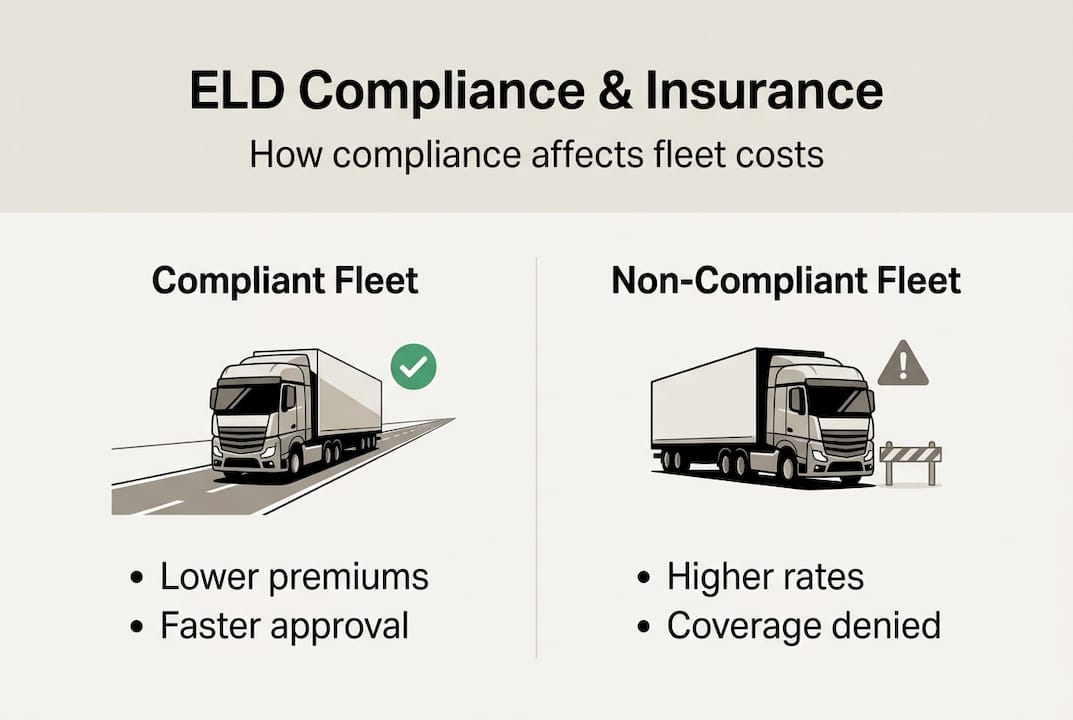
ELD compliance directly influences both your premium rates and whether carriers will offer you coverage at all. Here’s how compliant and non-compliant fleets compare:
Factor | Compliant fleet | Non-compliant fleet |
Premium rates | Lower, often discounted | Higher, sometimes 20-40% above average |
Eligibility | Broader carrier access | Limited or denied coverage |
Audit risk | Lower FMCSA scrutiny | High audit and penalty exposure |
Claims history | Better driver behavior patterns | Higher accident frequency |
Renewal process | Smoother, faster | Requires extensive documentation |
Real-world scenarios make this concrete. A 30-truck fleet with two ELD violations in 12 months may find their renewal quote jumps significantly. A fleet with zero violations and clean data exports often qualifies for reduced trucking premiums that competitors without strong compliance records simply cannot access.

Insurers also look at how you manage insurance risk strategies more broadly, and ELD data is one piece of that picture. Telematics data showing consistent speed management, proper rest periods, and predictable routes signals a lower-risk operation.
Pro Tip: Before your next renewal, pull a 90-day ELD compliance summary and send it proactively to your broker. Carriers reward fleets that bring documentation without being asked. It signals maturity and reduces underwriting friction, which often translates directly to better rates. You can also review insurance tips for trucking companies to see what else carriers look for during renewal evaluations.
Now that we’ve outlined what ELD compliance entails, it’s essential to understand its direct implications for your insurance options.
Practical steps for integrating ELDs and optimizing insurance
Proper ELD integration streamlines compliance and creates documented savings over time. Here’s a structured approach to getting this right:
Select FMCSA-registered hardware that meets 2026 tamper and telematics standards. Cross-reference the FMCSA ELD registry before purchasing.
Install and configure telematics integration so data flows automatically to your fleet management dashboard. Manual data entry defeats the purpose.
Train every driver on login procedures and editing protocols. Most violations come from drivers who don’t know the rules, not from intentional fraud.
Set up a secure data-sharing channel with your insurance broker. Most major ELD platforms allow encrypted exports. Monthly or quarterly uploads are typically sufficient.
Define which metrics to share: HOS compliance rate, total violation count, average hours per driver, and exception reports.
Schedule an annual ELD and insurance review. This should happen 60 days before your policy renewal so you have time to address any issues.
Document your internal audit process and keep 12 months of records accessible. Underwriters may request historical data during claims investigations.
Using smart freight shipping tips alongside proper ELD practices can further strengthen your operational profile when presenting to insurance carriers.
Pro Tip: Partner with an insurance agent who specifically understands ELD data and telematics. Agents who know the difference between a malfunction flag and a pattern of non-compliance can advocate for your fleet far more effectively. Read the motor carrier insurance guide to understand what specialized agents typically evaluate during the coverage assessment process. Also, when you’re ready to get quotes, understanding the right insurance quote strategy will help you get competitive offers faster.
To maximize both compliance and cost savings, here’s a step-by-step approach to implementation and collaboration.
Navigating common pitfalls: Compliance gaps and insurance denial
Even fleets with good intentions run into problems. ELD non-compliance can risk your insurance eligibility entirely, not just raise your rates. Here are the most common failure points:
Violation type | Insurance impact |
Outdated or unregistered ELD | Immediate eligibility issue |
Driver using paper logs instead | Major audit trigger |
Frequent manual log edits | Fraud risk flag |
Gaps in HOS data | Underwriting concern |
Data tampering evidence | Policy cancellation risk |
Review your 2026 shipping regulations calendar to stay ahead of any updated ELD requirements that could affect compliance standing.
Here’s how to address each gap proactively:
Outdated ELDs: Audit your device registry against the current FMCSA list every quarter. Replace non-listed devices immediately.
Poor driver training: Run mandatory ELD refresher sessions twice a year, especially after hiring new drivers.
Irregular usage: Set automated alerts for any trip where ELD data is missing or manually overridden.
Data tampering: Implement access controls so only authorized personnel can submit edits, with a full audit trail.
Missed certifications: Require drivers to certify their logs at the end of every shift, not weekly.
Regular internal audits are not just about catching problems. They create documented proof of your diligence, which is exactly what insurance carriers want to see when a claim or violation is disputed.
Your ISS score is directly affected by compliance violations, and underwriters check that score. A poor ISS score can trigger manual underwriting reviews, which slow down your policy approval and often result in higher premiums. Understanding what drives your score gives you a clear roadmap for improvement.
For fleets operating specific configurations, checking whether you qualify for bobtail insurance discounts is another way to reduce costs when your compliance record supports lower risk ratings.
Even with a solid plan, mistakes can happen, so let’s spotlight where fleets most often fail, and how to stay protected.
Perspective: Why smart ELD compliance is your hidden insurance lever
Here’s what most fleet operators miss: insurance companies are quietly building dynamic pricing models that use telematics data, including ELD records, to adjust premiums in near real time. This is already happening at several major carriers, and it will be industry standard within a few years. Fleets that are building clean, consistent ELD records right now are positioning themselves to benefit from this shift. Everyone else will be playing catch-up.
The bigger mistake we see is treating ELD compliance as purely a defense against audits. That’s the floor, not the ceiling. A well-maintained ELD record tells a story about your truck insurance strategy and operational maturity. Carriers love clients who make underwriting easy, and a clean data trail does exactly that.
The fleets winning on insurance costs right now are not the ones with the biggest trucks or the lowest claims history. They’re the ones who show up to renewal with organized documentation, a clear compliance narrative, and a demonstrated commitment to driver safety. That profile is increasingly rare, and carriers are willing to compete for it with better rates.
ELDs are a cost center on paper. In practice, they’re a risk management asset. Treat them that way.
Need support with ELD compliance or insurance?
For those looking to act on these insights, partnering with ELD-savvy insurance advisors can deliver immediate benefits. Aligning your compliance program with the right insurance structure is not a one-time task. It requires ongoing attention, the right data-sharing protocols, and a carrier relationship built on transparency.
At Insuaria, we work specifically with fleet operators who want to turn compliance into a coverage advantage. Our team understands ELD data, FMCSA reporting, and how to present your fleet’s risk profile in a way that attracts competitive quotes. Whether you need a compliance review, a fresh insurance assessment, or both, our inquiry services connect you with specialists who speak both the language of trucking and insurance. Reach out today and let’s build a strategy that works for your operation.
Frequently asked questions
What is the cost of implementing ELDs for a fleet in 2026?
Hardware costs range from $75 to $300 per truck as a one-time expense, and software subscriptions run $15 to $50 per month per truck, with volume discounts typically available for fleets over 25 vehicles.
Can ELD compliance lower my trucking insurance premium?
Yes, many insurers offer lower premiums for fleets with strong ELD records because compliance reduces risk and signals disciplined fleet management to underwriters.
What ELD features are insurers most interested in?
Insurers prioritize accurate HOS tracking, tamper resistance, and clear usage records because reliable ELD data gives them confidence in your fleet’s actual risk exposure.
What happens if my fleet isn’t ELD compliant?
Non-compliance triggers penalties including FMCSA audits, out-of-service orders, increased liability exposure, and can result in denied coverage or significantly higher insurance costs.
Recommended
Comments