Types of liability coverage for trucking fleets: 2026 guide
- Guyorguy Laguerre
- 3 days ago
- 9 min read


Trucking fleets operate in one of the most legally exposed industries in the country. A single accident involving a loaded semi can generate claims in the millions, and without the right liability structure, one incident can threaten your entire operation. FMCSA primary liability minimums range from $750,000 to $5 million depending on cargo type, yet many fleet owners still carry only the bare minimum. This guide breaks down every major liability coverage type, explains how they interact, and helps you build a protection strategy that matches your fleet’s actual risk profile.
Table of Contents
Key Takeaways
Point | Details |
Know the minimums | FMCSA mandates at least $750,000 in primary liability for trucking fleets, but most brokers require $1 million or more. |
Layer your protections | General liability, NTL, and umbrella policies fill essential gaps that primary coverage leaves open. |
Beware of exclusions | Understand what each liability policy excludes to avoid uninsured losses that could threaten your business. |
Distinguish policy types | Cargo and physical damage insurance protect your assets, not third-party liability exposures. |
How to evaluate liability needs for your fleet
With the stakes set, let’s clarify how you can weigh your fleet’s specific liability coverage needs. Before you compare policy options, you need a clear picture of what you’re actually protecting against. Liability selection is not a one-size-fits-all exercise. Your fleet’s size, cargo type, operating routes, and contractual relationships all shape what coverage you need and how much of it.
Start with the legal floor. FMCSA Title 49 regulations set minimum liability requirements for interstate carriers, but those minimums are just the starting point. Brokers and shippers routinely require $1 million or more in primary liability before they’ll place a load with you. If your limits fall short, you lose freight opportunities regardless of your safety record.
Here are the core factors that should drive your coverage evaluation:
Fleet size and vehicle type: Larger fleets with heavier equipment carry greater exposure per incident.
Cargo category: Hazardous materials carriers face the highest FMCSA minimums, up to $5 million.
Operating territory: Interstate routes trigger federal requirements; intrastate operations may follow state rules.
Contractual obligations: Broker agreements and shipper contracts often specify minimum limits.
Claims history: A history of losses drives up premiums and may limit your market options.
Statistic: Carrier insurance requirements show that most freight brokers now require at least $1 million in primary liability as a standard condition of doing business.
Pro Tip: Review your broker agreements annually. Minimum required limits have been climbing, and a contract you signed two years ago may now require higher coverage than your current policy provides.
Cost is always part of the equation. Factors like driver age, years in business, loss runs, and equipment value all affect your premium. For practical ways to manage these variables, insurance tips for trucking companies offers a solid starting framework. If you want to go deeper on cost drivers, reducing trucking insurance costs explains the specific levers you can pull.
Primary liability: Your compliance foundation
Once you’ve mapped your fleet’s risk and compliance landscape, start with primary liability, the core requirement. This is the coverage that every motor carrier engaged in interstate commerce must carry by federal law. No exceptions.
Primary liability covers bodily injury and property damage that your truck causes to third parties. If your driver rear-ends a passenger vehicle on the highway, primary liability pays for the other driver’s medical bills, vehicle repairs, and any resulting legal costs. It is the financial backstop that protects the public and keeps your operating authority active.
Primary liability is federally mandated and covers third-party injuries or property damage caused by your commercial vehicle during the course of business operations. The FMCSA sets the following minimum limits based on cargo type:
General freight (non-hazmat): $750,000
Household goods: $750,000
Oil transport: $1,000,000
Hazardous materials: Up to $5,000,000
What primary liability does not cover is equally important to understand:
Driver injuries (covered by occupational accident or workers’ comp)
Damage to your own truck or trailer (physical damage coverage)
Pollution or environmental cleanup
Loss or damage to the freight you’re hauling (cargo insurance)
Statistic: The carrier insurance requirements guide notes that the trucking industry standard for primary liability sits at $1 million, well above the federal floor for general freight carriers.
Pro Tip: Even if FMCSA only requires $750,000, carrying $1 million in primary liability is effectively the market minimum. Anything less and you’ll find yourself locked out of most broker freight boards.
For fleet managers who are newer to commercial coverage, truck insurance basics provides a clear overview of how primary liability fits into your broader insurance program.
Truckers general liability and non-trucking liability: Filling key gaps
Primary liability is essential, but gaps remain. Here’s where additional liability categories step in. Primary auto liability only responds when your truck is actively operating as a commercial vehicle. The moment an incident happens off the road or outside of dispatch, you can find yourself exposed.

Truckers General Liability (GL) covers business risks that have nothing to do with driving. Think of a customer slipping and falling at your terminal, a loading dock incident that injures a dock worker, or an advertising claim tied to your company’s marketing. General liability covers non-driving incidents and is often required by freight brokers as a condition of carrier approval. Common GL limits are $1 million per occurrence and $2 million aggregate.
Non-Trucking Liability (NTL), sometimes called bobtail insurance, fills a different gap. It protects your driver when the truck is being used for personal purposes or when the driver is not under dispatch. If a leased owner-operator takes the truck to run a personal errand and causes an accident, the motor carrier’s primary policy typically won’t respond. Non-trucking liability fills coverage for those off-dispatch moments.
Coverage type | When it applies | What it covers |
Primary auto liability | Active commercial operation | Third-party injury and property damage |
Truckers general liability | Non-driving business activities | Premises, loading, advertising injury |
Non-trucking liability | Personal use, off dispatch | Third-party injury when not on a load |
For a deeper look at bobtail and NTL options, bobtail insurance coverage walks through how these policies work in practice. Additional trucking insurance coverage options are outlined by DAT for carriers evaluating their full program.
Pro Tip: If you lease owner-operators, require them to carry NTL as a condition of their lease agreement. It protects them and reduces your exposure when they’re off the clock.
Excess/umbrella liability and the rise of nuclear verdicts
Once baseline protections are in place, some risks can still overwhelm standard coverage levels, especially in headline-grabbing legal cases. This is where excess and umbrella liability become critical.
Excess liability sits directly above your primary policy and pays when a claim exceeds your base limit. Umbrella liability is broader, covering gaps across multiple underlying policies. Both serve the same core purpose: extending your protection when a catastrophic claim blows past your standard limits.
The trucking industry is facing a litigation crisis. Nuclear verdicts drive up the need for excess and umbrella policies, with average nuclear verdicts in trucking cases reaching $36 million. These are jury awards of $10 million or more, and they are becoming more common, not less.
Year | Average nuclear verdict (trucking) | Premium impact |
2020 | $22 million | 8% increase |
2022 | $28 million | 14% increase |
2024 | $36 million | 18-20% increase |
“A single catastrophic accident involving multiple fatalities can generate a verdict that wipes out a fleet’s primary and excess coverage in one case.” — Commercial trucking insurance trends
Brokers and shippers are responding by requiring $2 million or more in excess layers as a standard contract term. For larger fleets running high-value lanes, $5 million to $10 million in total liability limits is increasingly common. To understand how these layers fit your overall program, fleet operator insurance needs provides a complete guide to building a layered coverage structure.
MCS-90 endorsement, cargo, and physical damage: Compliance backstops and common misconceptions
Beyond traditional liability, certain endorsements and policies are frequently misunderstood or overestimated. Getting these wrong can leave you thinking you’re covered when you’re not.
Here are the four most important distinctions every fleet manager needs to understand:
MCS-90 is not insurance. It is a federal endorsement attached to your primary policy. MCS-90 ensures payment of FMCSA minimums to third parties even if a technical policy exclusion would otherwise void coverage. It protects the public, not your business. If MCS-90 pays a claim that your insurer would have denied, your insurer can seek reimbursement from you.
Cargo insurance is not liability coverage. It is a first-party policy that pays for loss or damage to the freight you’re hauling. Cargo covers goods, not third-party liability. A cargo claim does nothing to protect you if a third party is injured in the same incident.
Physical damage covers your equipment, not others’ losses. Collision and comprehensive coverage pay to repair or replace your truck and trailer. They have no connection to third-party liability.
Gaps between these policies create real exposure. A fleet that carries cargo and physical damage but skimps on primary liability is exposed to the most financially devastating claims.
For compliance-focused fleet managers, motor carrier compliance breaks down how MCS-90 and related endorsements fit into your regulatory obligations.
Our take: Stop treating liability as a compliance checkbox
Here’s the uncomfortable truth most insurance conversations avoid. A lot of fleet owners buy liability coverage to satisfy a broker requirement and then stop thinking about it. They hit the minimum, file the certificate, and move on. That approach made sense in a different legal environment. It does not make sense in 2026.
The litigation landscape has fundamentally changed. Plaintiff attorneys are more aggressive, juries are more sympathetic to accident victims, and the dollar amounts being awarded are staggering. A $750,000 primary limit was adequate protection in 1985 when FMCSA set that floor. Today, it barely covers the medical costs from a serious accident, let alone the legal fees, pain and suffering awards, and punitive damages that can follow.
We’ve seen fleet owners lose businesses they spent decades building because they treated liability as a line item to minimize rather than a strategic investment. The math is simple. A $36 million nuclear verdict against a fleet carrying $1 million in primary and no excess coverage means $35 million in uninsured exposure. That’s not a risk management strategy. That’s a business-ending gamble.
The right approach is to build your liability program from the top down, not the bottom up. Start by asking what the worst realistic claim against your fleet looks like, then work backward to make sure your coverage layers can absorb it. Add excess coverage before you think you need it, because by the time you need it, it’s too late to buy it.
Build a liability program that actually protects your fleet
Understanding coverage types is the first step. Putting the right program together is where it gets real.
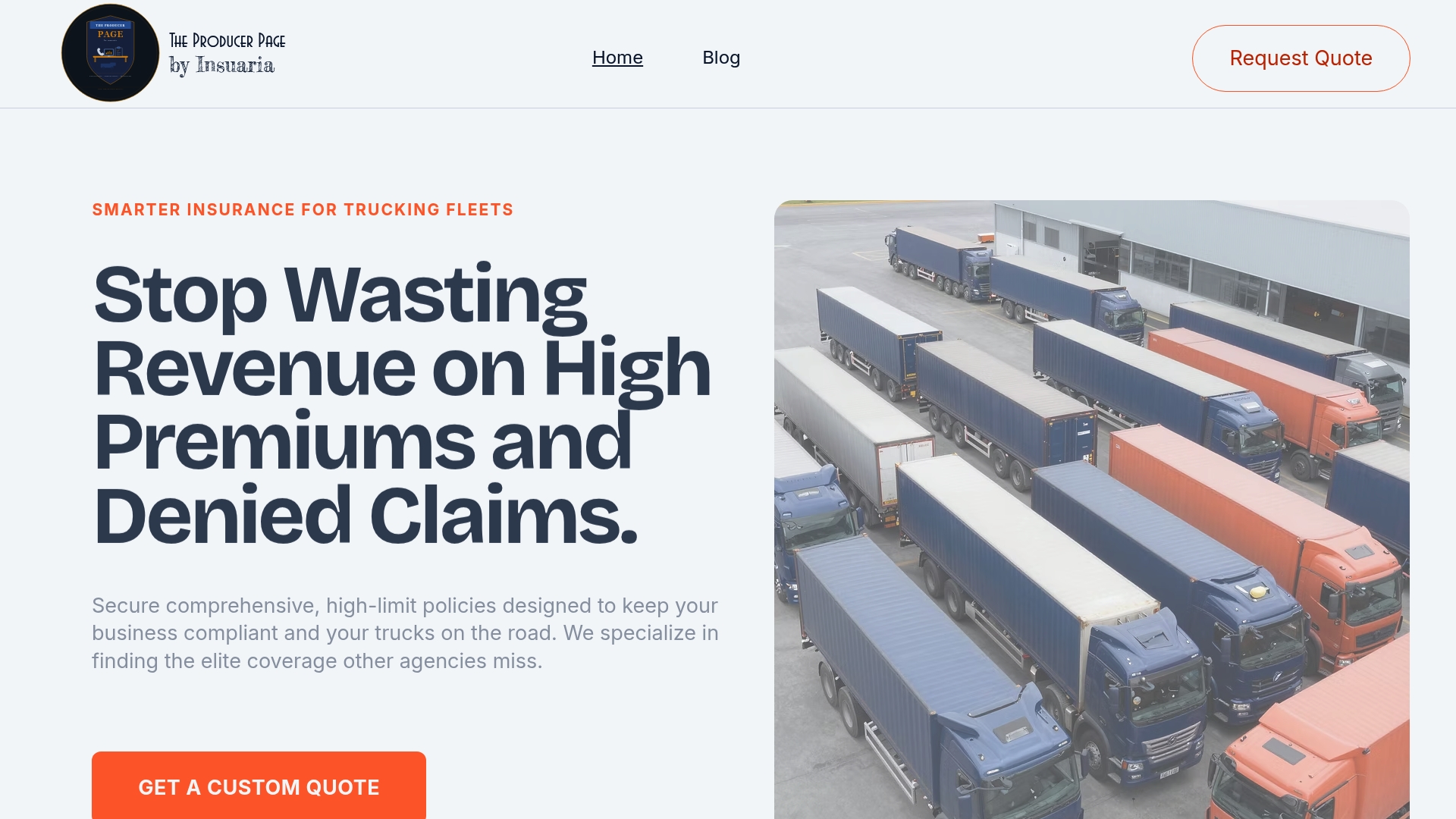
At Insuaria, we work exclusively with commercial trucking fleets to structure liability programs that go beyond compliance minimums. Whether you need to layer excess coverage above your primary policy, add truckers GL for broker requirements, or sort out how MCS-90 fits your operating authority, our team builds programs around your actual risk profile, not a generic template. Request a quote through our platform and get a customized coverage analysis built for your fleet’s specific routes, cargo, and contractual obligations. Your liability program should be a competitive advantage, not an afterthought.
Frequently asked questions
Which liability coverage is legally required for trucking fleets?
Primary commercial auto liability is federally required for all interstate carriers, with minimums starting at $750,000 depending on cargo type and rising to $5 million for hazardous materials.
What does truckers general liability cover that primary liability does not?
Truckers GL covers non-driving business risks like premises liability, loading dock incidents, and advertising injury, all of which are excluded from primary auto liability policies.
Why is excess or umbrella liability important for trucking companies?
Nuclear verdicts averaging $36 million in trucking cases mean standard primary limits can be exhausted by a single catastrophic claim, making excess layers essential for real financial protection.
Does cargo insurance count as liability coverage?
No. Cargo insurance covers goods you haul against loss or damage, but it provides no protection against third-party injury or property damage claims from an accident.
Recommended
Comments