Must-Have Coverages for Trucking Businesses in 2026
- Guyorguy Laguerre
- May 20
- 10 min read


TL;DR:
Running a trucking business requires comprehensive insurance coverage to protect your trucks, drivers, freight, and finances. Most operators underestimate the importance of proper liability, cargo, non-trucking, and occupational accident policies while overlooking coverage gaps and the need for bundling and tailored limits. Effective risk management involves understanding federal standards, broker demands, operational risks, and continuously reviewing your coverage to build a resilient and compliant program.
Running a trucking business means you are always moving, but one wrong insurance decision can stop everything cold. The must-have coverages for trucking operations go well beyond a simple auto policy, and figuring out what you actually need versus what regulators require versus what brokers demand is where most operators get tripped up. This article breaks down every major coverage type, explains when each one matters, and gives you the framework to build a program that protects your trucks, your drivers, your freight, and your bottom line.
Table of Contents
What you need to know before selecting must-have coverages for trucking
6. Workers’ compensation and occupational accident insurance
Comparing coverage options: limits, costs, and practical trade-offs
Situational recommendations: tailoring your trucking insurance program
My take on trucking coverage gaps and what I keep seeing operators get wrong
How Insuaria helps trucking businesses organize their coverage needs
Key takeaways
Point | Details |
Federal minimums fall short | FMCSA minimums are outdated; brokers standardize at $1M liability regardless of cargo type. |
Cargo coverage is broker-driven | Brokers typically require $100K minimum cargo coverage, but high-value freight often demands $250K or more. |
Gap coverages are often skipped | Bobtail and non-trucking liability protect you when trucks operate off dispatch, a risk most operators overlook. |
Bundling saves real money | Combining liability policies with one carrier can cut premiums by 10 to 15 percent. |
Owner-operators need occupational accident | Workers’ compensation is largely unavailable to owner-operators; occupational accident insurance fills that gap. |
What you need to know before selecting must-have coverages for trucking
Before you choose any policy, you need to understand the forces shaping your coverage decisions. There are three distinct sets of requirements pulling at you simultaneously: federal regulations from the FMCSA, broker and shipper insurance demands, and your own operational risk profile.
Regulatory minimums versus broker expectations
The FMCSA mandates minimum liability of $750,000 for general freight, $1,000,000 for household goods movers, and up to $5,000,000 for hazardous materials carriers. Those numbers have not changed since 1985. In practice, more than 95% of freight brokers require $1,000,000 regardless of what you haul. That gap between the legal floor and the market standard catches new operators off guard almost every time.
How cargo type shapes your program
The freight you haul dictates how much coverage you actually need. Dry van haulers moving pallets of consumer goods face different exposure than refrigerated carriers moving pharmaceuticals or flatbeds moving construction equipment. Broker cargo minimums typically sit at $100,000, but reefer loads and electronics shipments regularly require $250,000 to $500,000 in motor truck cargo coverage. Know your freight before you talk to an agent.
Operational scope and cost drivers
Solo owner-operators, small fleets of two to ten trucks, and large fleets face fundamentally different risk exposures. Financed equipment requires physical damage coverage as a lender condition, not just a smart choice. Trucks used occasionally for personal errands need non-trucking liability to avoid uninsured gaps. Annual commercial truck premiums typically run $8,500 to $14,000 per truck, so understanding what drives your costs gives you real leverage at renewal.
Pro Tip: Before your first conversation with an insurance professional, write down your three most common cargo types, your equipment financing status, and whether any drivers use trucks off duty. This one page of notes will make the coverage discussion faster and more targeted.
1. Primary liability insurance
Primary liability is the foundation of every trucking insurance program. It covers bodily injury and property damage you cause to third parties while operating under dispatch. Without it, you cannot legally operate as a for-hire carrier, and no broker will touch you.
The practical standard in the market is $1,000,000 per occurrence. The federal floor of $750,000 for general freight is technically sufficient for FMCSA compliance, but brokers universally require $1M to assign loads. Think of $750,000 as the license to operate and $1,000,000 as the license to actually work. If you are hauling hazardous materials, your exposure jumps to $5,000,000, which is an entirely different budget conversation.
2. Physical damage coverage
Physical damage covers your truck and trailer against collision, theft, fire, vandalism, and weather events. It is optional under federal law but required by virtually every lender or leasing company. Even if you own your equipment outright, skipping this coverage means a single accident or theft claim could wipe out a $150,000 asset.
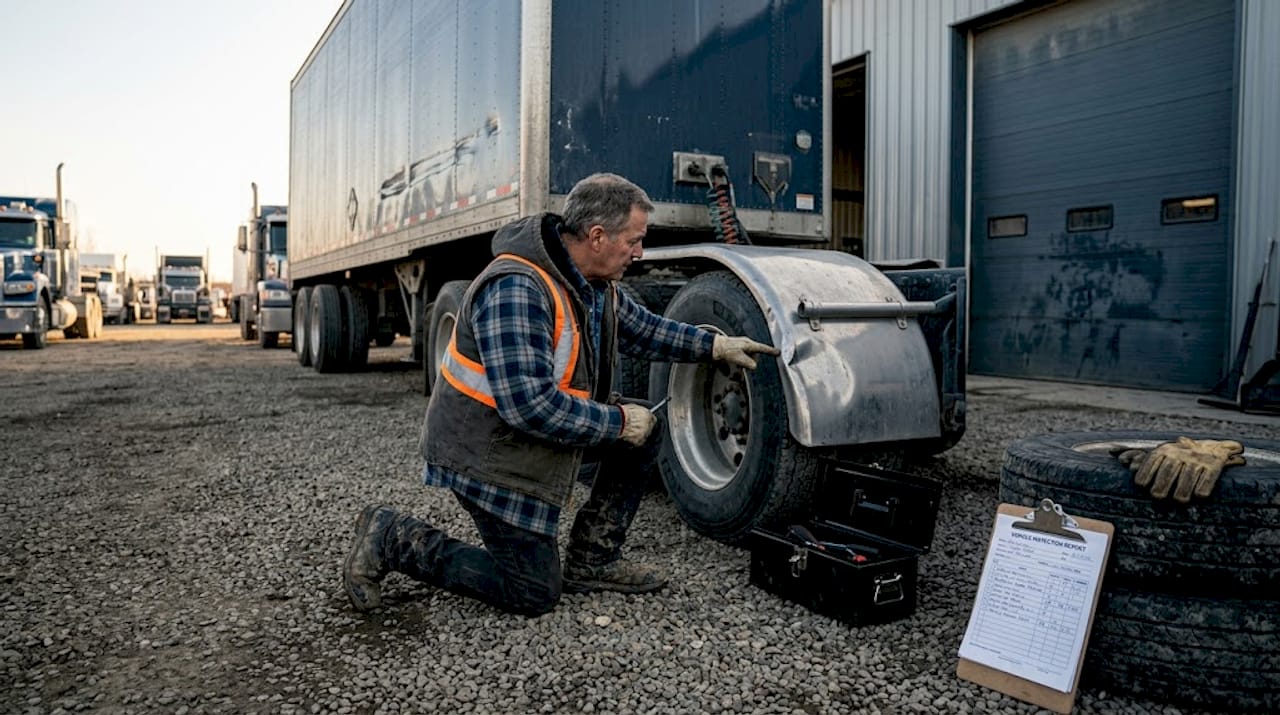
Physical damage insurance splits into two components: collision, which covers impact damage, and comprehensive, which covers everything else. Both matter. A truck totaled by a flood in a staging yard is a comprehensive claim, not a collision claim. Carry both, and check the coverage limits against actual replacement value, not book value.
3. Motor truck cargo insurance
Cargo insurance protects the freight you are hauling when it is damaged, lost, or stolen while in your care, custody, and control. Shippers and brokers require it for a reason: if a load of electronics is destroyed in an accident and you are uninsured, you are personally liable for the loss.
Standard broker cargo minimums start at $100,000, but that number is often inadequate for real-world loads. Learn more about cargo coverage limits before you set your policy limits. Pay close attention to policy exclusions: most cargo policies exclude damage from improper loading, refrigeration breakdown unless specifically endorsed, and certain high-theft commodities like electronics or tobacco.
4. Non-trucking liability and bobtail insurance
This is the coverage gap that catches operators by surprise. Primary liability only applies when you are under dispatch hauling freight for a motor carrier. The moment you drive the truck off dispatch, whether it is going home for the night or running a personal errand, that coverage stops. Non-trucking liability and bobtail insurance fill that gap.
The distinction between the two is subtle. Bobtail covers the truck operating without a trailer regardless of whether you are under dispatch. Non-trucking liability covers personal use specifically. Many agents use the terms interchangeably, so confirm exactly what triggers coverage with your licensed professional. At $300 to $600 per year, this is one of the most cost-effective coverages in any trucking program.
5. General liability insurance
General liability covers incidents that happen off the road and outside of vehicle operation. Think about what happens when a driver drops a pallet while unloading at a customer’s warehouse, or when someone slips and falls at your terminal. Primary liability does not cover those situations.
For fleet operators with multiple drivers, a terminal, or regular customer-site operations, general liability is not optional in practice. It covers bodily injury, property damage, and certain personal injury claims arising from your business operations beyond the truck itself. Limits typically start at $1,000,000 per occurrence with a $2,000,000 aggregate.
6. Workers’ compensation and occupational accident insurance
Driver injuries are expensive and frequent. Workers’ compensation is mandatory in most states for companies with employees, covering medical bills and lost wages when a driver gets hurt on the job. If you have W-2 drivers on payroll, this is not a discretionary coverage.
The situation changes for owner-operators. Workers’ comp is generally not available to self-employed individuals, which creates a dangerous gap. Occupational accident insurance fills that role, providing medical coverage and income replacement for injuries sustained on the job. Policies typically run $100 to $250 per month. Skipping it to save money is a decision that can result in financial ruin from a single serious injury.
Pro Tip: If you lease owner-operators rather than employ W-2 drivers, confirm in writing what coverage the carrier provides for those drivers and where the gaps are. The answer shapes whether you need to offer occupational accident insurance as part of the lease agreement.
7. Umbrella and excess liability insurance
Trucking accidents can generate enormous legal judgments. Nuclear verdicts exceeding $100 million have become more common, and a $1,000,000 primary liability limit can be exhausted quickly in a serious multi-vehicle accident. Umbrella and excess liability policies sit on top of your primary liability to extend your total coverage limit affordably.
A $5,000,000 umbrella policy typically costs a fraction of what it would cost to raise your primary limits to the same level. For fleet operators with significant assets to protect, an umbrella policy is not a luxury. It is the coverage that stands between a bad accident and a business-ending judgment.
Comparing coverage options: limits, costs, and practical trade-offs
Understanding each coverage type individually is only half the equation. You also need to see how they stack against each other in terms of cost, limits, and when each one becomes critical.
Coverage Type | Typical Limit | Annual Premium Range | When It Becomes Critical |
Primary liability | $1,000,000 per occurrence | $5,000–$9,000 | Every load, every mile under dispatch |
Physical damage | Actual cash value of truck | $1,500–$4,000 | Financed equipment, single-truck operations |
Motor truck cargo | $100,000–$500,000 per load | $1,000–$3,000 | Every load with shipper/broker requirements |
Non-trucking liability | $1,000,000 per occurrence | $300–$600 | Off-dispatch personal or deadhead driving |
General liability | $1M/$2M occurrence/aggregate | $500–$1,500 | Terminal operations, customer-site deliveries |
Occupational accident | Varies by benefit schedule | $1,200–$3,000 | Owner-operators without workers’ comp access |
Umbrella/excess liability | $5M–$10M+ | $1,500–$3,500 | Large fleets, high-value cargo, nuclear verdict exposure |
Deductible strategy matters more than most operators realize. Raising your physical damage deductible from $1,000 to $2,500 can save $800 to $1,200 per year. That math works in your favor if you have the cash reserves to cover that deductible when a claim hits. If your operating account runs lean, a low deductible is worth the higher premium.
Bundling is a legitimate cost lever. Combining primary and general liability with the same carrier typically yields 10 to 15 percent in premium savings. Beyond the savings, having one carrier for multiple policies simplifies claims management considerably.
Pro Tip: When comparing quotes, ask each agent to show you the total annual cost of your full program, not just individual policy premiums. A carrier that is $400 cheaper on primary liability but $700 more expensive on cargo is not actually the better deal.
Situational recommendations: tailoring your trucking insurance program
The right insurance program looks different depending on your operation. Here is how to think about coverage priorities based on your specific situation.
Solo owner-operators
If you are running one truck under a permanent lease to a motor carrier, the carrier’s primary liability likely covers you while under dispatch. Your priorities become:
Non-trucking liability to cover you off dispatch
Occupational accident insurance as a substitute for workers’ comp
Physical damage if your truck is financed
Motor truck cargo if your lease requires it or if you handle your own broker relationships
Small fleets (two to fifteen trucks)
At this scale, you are exposed on multiple fronts simultaneously. Your priorities shift to:
Primary liability at $1,000,000 with consideration for excess coverage
Physical damage across the entire fleet, with deductible levels matched to your cash reserves
Workers’ compensation for all employed drivers
General liability if drivers operate at customer facilities
A fleet umbrella policy to cap catastrophic exposure
High-value or hazardous cargo operations
If you are hauling pharmaceuticals, electronics, precious metals, or hazardous materials, standard limits are not enough. Cargo coverage limits of $250,000 to $500,000 per load are common. Primary liability for hazmat carriers must reach $5,000,000. Work with a licensed professional who specializes in your cargo type.
Budget-conscious operators
Cutting coverage to save money is a real risk, but there are smarter ways to manage costs. Consider trucking insurance strategies like bundling policies, raising physical damage deductibles to match your cash reserves, and reviewing your coverage annually to adjust limits as your fleet value changes. A commercial truck insurance review with a licensed professional once a year costs you nothing and can surface significant savings.
My take on trucking coverage gaps and what I keep seeing operators get wrong
I have reviewed a lot of trucking insurance programs over the years, and the same gaps show up over and over again. The first one is treating federal minimums as a planning target. The FMCSA’s $750,000 floor was set in 1985. The legal environment has changed dramatically since then, and verdicts that would have been unthinkable a decade ago are now routine. Planning your coverage around a number that has not kept pace with inflation or legal risk is a mistake that feels like a budget win until it is not.
The second gap I see constantly is the off-dispatch blind spot. Operators assume their insurance covers the truck at all times. It does not. A 2026 Supreme Court ruling removed a key legal protection for freight brokers, which has pushed brokers to scrutinize carrier insurance certifications more aggressively than ever. That pressure is flowing downstream to carriers. Brokers are not just checking whether you have coverage. They are checking whether your coverage is airtight.
The third thing I want operators to think about is occupational accident insurance. I have seen owner-operators skip this because $150 a month feels like a lot when margins are thin. Then one slip climbing down from a cab leads to surgery, six weeks off the road, and no income replacement. The math on that is brutal. Get the coverage.
My practical advice is to stop treating insurance as a compliance checkbox and start treating it as a financial planning tool. The operators who manage their programs well, bundle where they can, set deductibles based on actual cash flow, and review annually are the ones who build sustainable businesses. The ones who chase the cheapest policy every year are the ones who end up underinsured at exactly the wrong moment.
— Guyorguy
How Insuaria helps trucking businesses organize their coverage needs
Knowing what coverages you need is one thing. Getting your information organized and in front of the right licensed professionals quickly is another challenge entirely.
Insuaria is built specifically to make that first step easier. Through simple intake forms designed for fleet operators, Insuaria helps trucking business owners organize the details that licensed insurance professionals need to review their coverage program. Whether you are a solo owner-operator building your first program or a fleet manager reassessing coverage across fifteen trucks, Insuaria’s platform helps you submit your information clearly and efficiently. Start by completing a business insurance intake to get your information in front of a licensed professional, or use the truck insurance intake to initiate a coverage review for your vehicles. Insuaria does not sell or bind coverage but connects you with the licensed professionals who do.
FAQ
What is the minimum liability coverage for trucking?
The FMCSA requires a minimum of $750,000 for general freight carriers, but in practice, virtually all freight brokers require $1,000,000 before assigning loads, making $1M the real working standard.
Is cargo insurance required for trucking?
Cargo insurance is not federally mandated at high levels, but most freight brokers require a minimum of $100,000, and high-value freight regularly requires $250,000 to $500,000 or more.
What does bobtail insurance cover?
Bobtail insurance covers your truck while it is being driven without a trailer, including periods when you are off dispatch or traveling between assignments, filling a gap that primary liability does not address.
Do owner-operators need workers’ compensation?
Workers’ compensation is generally not available to self-employed owner-operators. Occupational accident insurance serves as the practical alternative, providing medical and income coverage for on-the-job injuries at a cost of roughly $100 to $250 per month.
When does an umbrella policy make sense for trucking?
An umbrella policy makes sense for any fleet operator with significant assets or high cargo exposure. Given that nuclear verdicts exceeding $100 million have become more frequent in trucking litigation, extending your liability limits beyond $1,000,000 is a financially sound decision for operations of any meaningful size.
Recommended
Comments