Why choose specialized trucking insurance for your fleet
- Guyorguy Laguerre
- May 17
- 10 min read


TL;DR:
Minimum insurance coverage does not adequately protect trucking businesses from multi-layered risks that exceed basic limits during incidents. Specialized trucking insurance coordinates multiple coverages like cargo, liability, and excess layers, while ensuring FMCSA filings remain active to maintain legal operating authority. Recognizing the impact of outdated minimums and rising nuclear verdicts emphasizes the need for tailored coverage to safeguard financial stability in 2026.
Minimum insurance satisfies the checkbox, but it doesn’t protect your business. Most trucking operators understand that coverage is legally required, but fewer realize just how far below actual risk exposure those minimums sit. When you’re evaluating why choose specialized trucking insurance, the answer isn’t abstract. A single incident on the road can generate simultaneous vehicle damage, cargo loss, liability claims, and lost revenue, and a standard commercial policy rarely accounts for all four hitting at once. As overlapping losses in trucking often exceed what minimum coverage addresses, the stakes of getting this wrong are high.
Table of Contents
How compliance and FMCSA insurance filings affect your authority to operate
The rising financial risks: outdated minimums and the impact of nuclear verdicts
How specialized insurance agents simplify compliance and tailor coverage
Managing rising insurance costs: practical strategies for trucking businesses
Why specialized trucking insurance is your strongest business asset in 2026
Get tailored specialized trucking insurance and compliance support
Key Takeaways
Point | Details |
Minimum coverage mismatch | Federal insurance minimums have not kept pace with modern litigation risks, leaving many trucking companies underprotected. |
Overlapping risks need coordination | Specialized insurance accounts for how accidents trigger multiple types of losses simultaneously, reducing financial surprises. |
FMCSA filings are crucial | Maintaining correct BMC-91 and related filings is essential for legal operating authority and avoiding suspensions. |
Specialized agents add value | Agents with trucking expertise streamline compliance, tailor coverage to contracts, and advocate through claims. |
Cost control strategies matter | Using safety technology and specialized programs helps manage rising insurance costs effectively. |
Understanding the unique risks in trucking insurance
To grasp why specialized trucking insurance matters, first consider what trucking businesses are actually up against daily. Commercial trucking doesn’t operate in a clean, single-category risk environment. A warehouse fire or a retail slip-and-fall creates one type of loss. A trucking incident creates several at the same time, and your coverage needs to respond to all of them simultaneously, not just the largest one.
A single accident can trigger equipment damage, liability claims, cargo loss, and operational downtime all at once. That’s not an edge case. That’s a routine catastrophic event in trucking, and it’s the kind of scenario that exposes the gaps in generic commercial policies built for stationary businesses.
Consider what actually happens when a flatbed carrying construction equipment jackknifes on an interstate. The truck is damaged. The cargo is destroyed. Another driver’s vehicle is totaled. Traffic halts deliveries for hours. Your client is filing a breach-of-contract claim because the load didn’t arrive. Every one of those problems needs a policy response, and they’re all happening simultaneously.
Here’s what minimum coverage misses in that scenario:
Cargo liability: Many base commercial truck policies don’t include motor truck cargo coverage, leaving the value of the freight entirely unprotected.
Operational downtime: Lost revenue while your truck is in the shop doesn’t appear on a standard liability policy.
Bobtail or non-trucking liability: If your driver was between loads when the incident occurred, some policies don’t even respond.
Excess liability: When the claim totals exceed your primary limit, you need an umbrella or excess layer. Without it, you pay the difference.
Understanding essential fleet coverages and how they coordinate is foundational to this conversation. It’s also worth understanding cargo liability risks separately, because cargo coverage is frequently misunderstood until a claim is denied.
“The importance of trucking insurance lies not just in meeting legal thresholds, but in coordinating all the coverages that respond to a trucking incident, so no single loss falls through the gaps.”
Specialized trucking insurance is built around this reality. It bundles and coordinates coverages so that when something goes wrong, your insurer isn’t pointing at another policy to pick up the tab.
How compliance and FMCSA insurance filings affect your authority to operate
Beyond risk coverage, compliance with FMCSA insurance filings is another critical reason to choose specialized trucking insurance. The Federal Motor Carrier Safety Administration (FMCSA) doesn’t just require that you have insurance. It requires that your insurer file proof of that insurance electronically on your behalf, using specific forms that confirm your coverage meets federal standards.
The primary form is the BMC-91/BMC-91X, which is filed by your insurance carrier directly with the FMCSA. Without it, your operating authority doesn’t get activated, or it gets suspended. This isn’t a technicality that comes up once. Without an active BMC-91/BMC-91X on record, FMCSA will not activate operating authority and will suspend authority if the filing lapses. That means your business stops legally operating the moment the filing goes dark.
Here’s a sequence that plays out more often than most operators expect:
Policy lapses or cancels: Your insurer sends notice, but you’re busy and the renewal slips.
BMC filing is withdrawn: The carrier automatically notifies FMCSA when coverage ends.
FMCSA suspends your authority: This can happen within days of the filing withdrawal.
You can’t haul legally: Loads get canceled, contracts get voided, and penalties accumulate.
Reinstatement takes time: Getting authority reinstated isn’t instant. The process involves fees, refiling, and waiting periods.
Carriers using standard commercial insurance often discover mid-crisis that their policy didn’t include the BMC filing as part of the package. Specialized trucking insurance programs build these filings into the policy management process from day one.
Pro Tip: When reviewing any trucking insurance program, confirm in writing that BMC-91/BMC-91X filings are handled directly by your insurer and that you’ll receive advance notice before any policy cancellation triggers a filing withdrawal. This one step prevents most compliance emergencies.
Starting with well-organized information makes this process significantly easier. Specialized trucking paperwork help through platforms that streamline intake reduces the chance of filing errors from the start.
The rising financial risks: outdated minimums and the impact of nuclear verdicts
Financial risks in trucking insurance have increased dramatically due to outdated minimums and larger litigation verdicts. This is where many trucking business owners get blindsided, because they assume that meeting the federal minimum means they’re adequately covered. That assumption is increasingly dangerous.
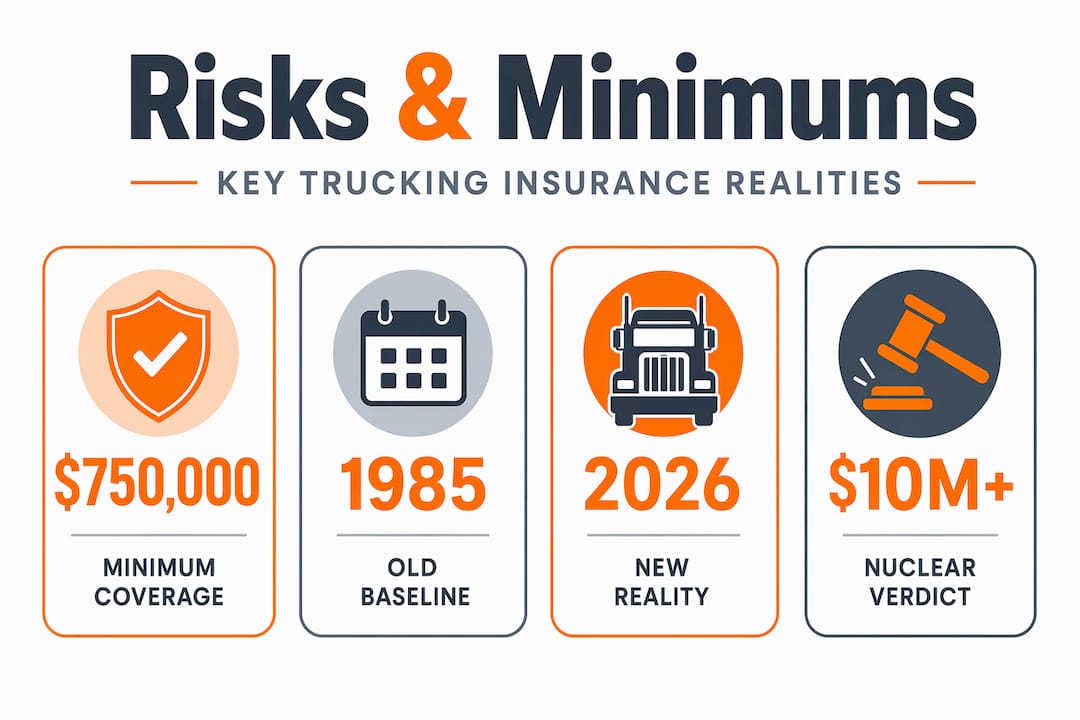
The federal minimum liability coverage for most for-hire carriers hauling non-hazardous freight is $750,000. That number has not changed since 1985, while nuclear verdicts in trucking cases now frequently reach tens of millions of dollars. A nuclear verdict is a jury award that vastly exceeds what most would consider a reasonable settlement, often driven by aggressive plaintiff attorneys pursuing “reptile theory” trial strategies designed to frame trucking companies as predatory actors.
“The gap between the 1985 federal minimum and what juries are awarding today isn’t a policy footnote. It’s a business-ending liability exposure for any carrier operating at the minimum.”
Here’s a side-by-side look at how the numbers have diverged:
Coverage factor | 1985 baseline | 2026 reality |
Federal minimum for general freight | $750,000 | $750,000 (unchanged) |
Average nuclear verdict in trucking | Under $3 million | $50 million or more |
Typical excess exposure at minimum | Minimal | $49+ million |
Median large-loss trucking claim | Under $500,000 | Over $1 million |
Operating at the federal minimum today means you’re personally exposed to catastrophic financial loss the moment a jury decides to make an example of your company. Specialized trucking insurance addresses this by building in higher primary limits, excess liability layers, and umbrella coverage designed specifically around trucking litigation exposure.
The practical effect of understanding trucking insurance premiums and why they’ve been climbing is that you can make smarter decisions about where your coverage dollars go. Higher limits now are almost always cheaper than post-verdict personal liability.
Key takeaways on the financial exposure:
Carriers with $1 million or $2 million in primary coverage still face exposure on verdicts above those limits.
Umbrella policies written for trucking specifically follow the form of your primary trucking policy, meaning they respond correctly. Generic umbrellas sometimes don’t.
Litigation trends show no sign of reversal. Plaintiff law firms that specialize in trucking cases have grown significantly in the past decade.
How specialized insurance agents simplify compliance and tailor coverage
To handle these complexities, partnering with specialized insurance agents provides valuable operational and compliance benefits that general business insurance agents simply can’t replicate. The knowledge gap between a trucking-focused agent and a general commercial lines agent is wide, and it shows up at exactly the wrong moment: at claim time or during a compliance audit.

Trucking-focused agents ensure compliance with DOT, FMCSA, shipper, broker, and lender requirements without paying for unnecessary coverage. That last part matters. Specialized agents know which coverages are contractually required by the brokers and shippers you work with, and they won’t pad your policy with coverage types that don’t apply to your operation.
Here’s where specialized agents make a measurable operational difference:
Contract-specific certificate of insurance (COI) requests: Brokers and shippers often require specific additional insured endorsements and minimum limits. A specialized agent knows how to structure these correctly the first time.
Faster claims advocacy: When a claim hits, a trucking-specific agent speaks the language of trucking claims adjusters. They know which coverages respond first, how to document cargo damage for maximum recovery, and when to push back on a denial.
Reduced compliance errors: An agent who understands MCS-90 endorsements, cargo forms, and bobtail coverage doesn’t accidentally omit a required form.
Driver and fleet changes: Adding a driver or a unit triggers filing and underwriting requirements. Specialized agents handle these changes without letting your coverage lapse during transitions.
Pro Tip: Ask any prospective agent what percentage of their book of business is commercial trucking. An agent whose practice is primarily trucking is more likely to know your specific exposure than one who handles trucking as 10% of a general commercial portfolio.
Building confidence with trucking insurance starts before you even call an agent. Being clear on the liability coverage types relevant to your operation helps you ask better questions and recognize whether an agent knows their stuff.
Managing rising insurance costs: practical strategies for trucking businesses
While risk and compliance are critical, controlling rising insurance costs is equally important for trucking businesses today. Insurance costs rose to 10.2 cents per mile in 2024, with further increases expected due to accident frequency, repair costs, and litigation trends heading into 2026. For an operator running 100,000 miles per year, that’s $10,200 per truck in insurance costs alone, before factoring in cargo, non-trucking, and umbrella layers.
The good news is that cost management strategies exist, and they work. Here’s a practical sequence:
Install telematics and AI-enabled dashcams: Carriers using forward-facing dashcams that capture events with AI-triggered alerts see measurable reductions in at-fault accidents. More importantly, dashcam footage defeats fraudulent claims, which are a significant and growing cost driver in trucking.
Enforce a documented distracted driving policy: Insurers are increasingly asking about your policy on cellphone use and in-cab device distraction. A written policy with documented enforcement history signals lower risk to underwriters.
Implement driver coaching programs: Post-event coaching tied to telematics data reduces repeat incidents. Insurers know this, and many offer reduced trucking insurance premiums for carriers with formal coaching programs.
Share your driving data with insurers: Some specialized insurance programs offer usage-based insurance (UBI) models where your telematics data directly informs your premium. Carriers with clean data benefit from lower rates. Those who refuse to share data often pay a penalty rate.
Structure deductibles strategically: Higher deductibles on physical damage coverage can significantly reduce premiums for larger fleets that can self-insure smaller losses. A specialized agent can model the break-even point.
Review your loss runs annually: Errors on loss run reports can inflate your perceived risk. Specialized agents catch these. General agents often don’t.
The goal isn’t to buy the cheapest policy. The goal is to buy the right policy at the best price your safety record justifies.
Why specialized trucking insurance is your strongest business asset in 2026
Here’s what most insurance conversations miss: specialized trucking insurance isn’t just a legal obligation or a cost of doing business. It’s the difference between a business that survives a bad year and one that doesn’t.
Carriers who treat insurance as a commodity, price-shopping for the lowest premium and accepting whatever coverage comes with it, are essentially running a financial bet that nothing catastrophic will happen. That bet gets harder to win every year. The legal minimum coverage unchanged since 1985 was established in a litigation environment that bears almost no resemblance to today’s. Plaintiff attorneys who focus exclusively on commercial trucking have transformed what a verdict looks like, and carriers at or near the minimum are their preferred targets, because the insurer pays the policy limit and the carrier pays everything above it personally.
The uncomfortable truth is that many trucking businesses discover their coverage gaps during a claim, which is the worst possible time to find them. A specialized trucking insurance program eliminates this discovery-at-crisis pattern. When specialized insurance coordinates overlapping risks, the outcome of a claim is defined by your coverage structure, not by which insurer argues it’s another insurer’s problem.
The operators who are most resilient to the current insurance climate share a few things in common. They know exactly what each policy in their stack covers and where coverage ends. They have a trucking-focused agent who handles their filings, their certificates, and their claims. And they’ve invested in safety technology that simultaneously reduces accident frequency and gives them ammunition against fraudulent claims.
Choosing specialized trucking insurance is not a defensive move. It’s how serious carriers build a business that can absorb a bad incident and keep operating. Browse insurance tips for trucking companies to see how other operators are approaching this.
Get tailored specialized trucking insurance and compliance support
After working through what’s actually at stake, the next question is straightforward: where do you start?
Insuaria is built for exactly this moment. As a compliance-first intake and referral platform, Insuaria helps trucking business owners organize their coverage details through a simple intake process, so that licensed insurance professionals can review your specific situation and follow up with options that actually match your operation. You get organized, the right people get the right information, and the coverage review process moves faster.
Whether you’re managing a business insurance process review or looking to explore truck insurance quotes for your fleet, Insuaria connects your information directly to licensed agency partners who specialize in trucking. Start with the expert trucking insurance assistance intake form and take the first step toward coverage that actually fits what you haul, where you haul it, and who requires what from you.
Frequently asked questions
What makes specialized trucking insurance different from general commercial insurance?
Specialized trucking insurance is built to address trucking-specific exposures like cargo loss, bobtail liability, and operational downtime that general commercial insurance often excludes or underfunds. It coordinates multiple coverages so they respond together when an incident creates overlapping losses.
Why is the BMC-91 insurance filing important for motor carriers?
The BMC-91 is an electronic proof of insurance filed by your insurer directly with FMCSA. Without an active filing, FMCSA will not activate your operating authority and will suspend it if the filing lapses, meaning you cannot legally haul freight.
How have rising nuclear verdicts affected trucking insurance costs?
Nuclear verdicts have pushed liability exposure far beyond the 1985-era federal minimums, prompting insurers to raise premiums industrywide. Carriers operating near the minimum limit face personal financial exposure for any verdict that exceeds their policy limits.
Can specialized insurance agents help reduce delays and errors in insurance paperwork?
Yes. Specialized agents reduce delays by handling filings, certificates, and contract-specific endorsements correctly from the start, which prevents the compliance errors that can suspend operating authority or void coverage at claim time.
What are some effective strategies to manage rising trucking insurance costs?
Installing AI dashcams, enforcing documented driver safety policies, and sharing telematics data with your insurer are among the most effective approaches. Use of telematics and dashcams reduces both claims frequency and fraudulent claim exposure, which directly improves your premium position over time.
Recommended
Comments